
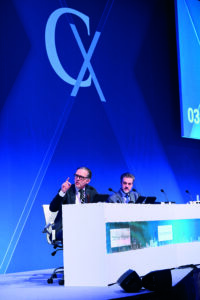
The use of physician-modified endografts (PMEGs) in juxtarenal abdominal aortic aneurysms (AAAs) through the prism of low-profile endografts, an artificial intelligence (AI)-assisted standardised approach for four-fenestration PMEG and outcomes from the SPHERE registry, along with PMEG for complex AAA based on a cross-sectional global survey opened an aortic consensus session yesterday morning at the 2026 Charing Cross (CX) Symposium (21–23 April, London, UK).
Taking a look at how to perform PMEG with low-profile grafts, Marc Schermerhorn (Boston, USA) outlined the current landscape stateside, making the case for the physician-modified method as the better approach.
“For the future, in the USA we’re going to have fenestrated, custom-made and we’re going to have branched off-theshelf devices, and that’s probably about it,” Schermerhorn said as he analysed the lay of the land in his homeland. “So PMEGs are not going to go away for a while because there is a need for hybrid grafts, there’s a need for more rapid grafts.
“And I put it to you that what you could do with a PMEG might actually be a little bit better. We could have a lower profile, we could have reinforced fenestrations, minimal interaction [with] a bifurcate nose cone with renal stents. We can do hybrid grafts—branched and fenestrations”, he added, mostly with a graft modification time of 45 minutes to an hour, he added.
“Low-profile grafts can be performed safely with low rates of endoleak, although there are others who are using PTFE cuffs, and, with these, I would encourage these [operators] to report their results,” Schermerhorn concluded. “And, if they are similar, then I think industry should start thinking about putting them onto their custom grafts.”
On the latter point, CX co-chair and session moderator Dittmar Böckler (Hamburg, Germany) accentuated Schermerhorn’s point, commenting that “by performing these PTFE cuffs you reduce the endoleak type 3c rate a lot and significantly.”
From the AI-assited, Michele Piazza (Padua, Italy) placed a lens over a standardised approach for four-fen PMEG through outcomes from the SPHERE registry. “When we talk about PMEGs, the main issue is the lack of standardisa-tion,” he said. This led his team to select a mode of standardisation by following the Society for Vascular Surgery (SVS) reporting standards formula, taking account of “not only the centreline but also the difference in the aorta and the oversizing of the graft”.
“Taking advantage of an AI-assisted process, we may now develop a new approach: We can create a digital print image of the aorta,” Piazza explained. “After that, we can automatically select the centreline, and then the only things the operator has to decide is where we want to land our graft proximally and what type of graft we want to use. After that, the machine can automatically identify the exact position of the ostium of the target vessel, and, similarly, we can also create a digital twin of the graft when we simulate. We can also simulate the fenestration and simulate the graft in transition into this digital twin aorta.”
The idea has potential, Piazza said, but the idea has to be moved on into real practice. To that end, results are entering the literature. “If we look at the early outcomes that we have published in a multicentre experience with this type of approach, 40% of those cases were para-renal, 35% were type 4 and 25% were juxtarenal,” he continued. Despite the high SVS score of those patients, “the early results were quite good”, with a 96% rate of technical success, zero deaths, zero strokes, and zero spinal cord ischaemia.
When comparing four-fenestration PMEG post-implantation analysis with AI, there were 25 cases, and about 100 target vessels. “We think that AI and digital print technologies are a valid tool to allow four-fen PMEG,” Piazza added. “In the near future, this approach may be safe in order to simplify and speed up the planning process. With an integrated, standardised approach, this has the potential to evolve toward a second-generation PMEG concept.”
From the floor, Michael Jenkins (London, UK) quizzed Piazza over “many years ago, Terumo Aortic, when they were doing the Anaconda programme, made what’s probably an analogue twin, in that they would make a polymer cast of the aorta” and fashion a method “to deliver it in that cast to predict, especially in tortuous anatomy, what was going to happen during implantation”. Adjustments could then be made, he added, saying, “this I see as the exciting area of this: have you compared physical casts to the digital twin process?” Piazza outlined a planning and simulation process that would take two to three minutes. “That is very fast,” Jenkins added. Medtronic have a digital twin programme for thoracic endovascular aneurysm repair (TEVAR) to show the likes of “areas of apposition to the wall”, he pointed out, “ but that takes a lot longer than perhaps the AI”.
Meanwhile, Maria Antonella Ruffino (Lugano, Switzerland) outlined indications, planning and technical aspects in PMEG for complex AAA. Based around a cross-sectional survey that takes in the USA and countries around the world, Ruffino pointed that if the European Society for Vascular Surgery (SVS) guidelines, PMEG should be considered only in case of emergencies. But this does not reflect real practice, she said. “So, the question that we bring at my hospital with my vascular surgeon colleagues is, ‘Are we all aligned with indications, strategies and technical choice for this procedure?’ and so we moved the question to the global community.”
Thus, the survey assessed real-world use. More than 4,000 surveys were disseminated to a multispecialty cohort, 85% of them vascular surgeons. “What we have seen since the beginning is that the experience is very different between the respondents,” Ruffino said. Most were performing less than 10 procedures and only 21% were doing more than 30 cases per year, while 60% of those centres were doing so without a high experience of fenestrations and practice, she added.
“This survey underlines the wide variability of PMEG but also some baseline to start digging into standarisation,” she added. “We need global cooperation between vascular socities.”