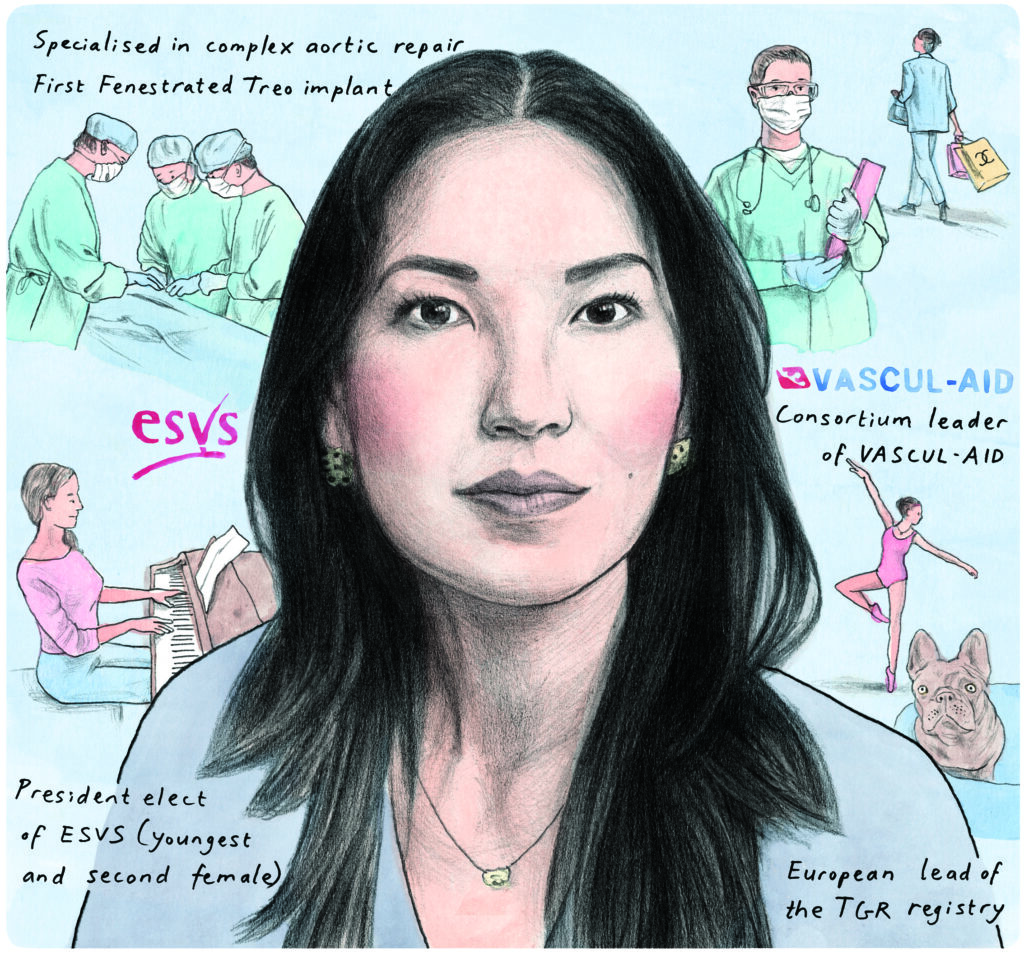
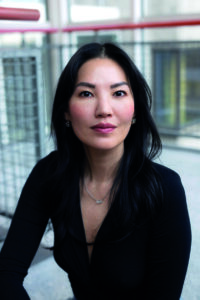
Soon to be the youngest and second-ever female president of the European Society for Vascular Surgery (ESVS), Kak Khee Yeung (Amsterdam, Netherlands) speaks to Vascular News about her career so far. The vascular surgeon and professor of vascular surgery at Amsterdam University Medical Center (UMC) covers her route into the specialty, current projects including the VASCUL-AID disease prediction platform, and why collaboration is crucial when it comes to moving the needle in vascular research.
Why did you choose to pursue a career in vascular surgery?
When I was a student at the University of Amsterdam, I became fascinated by vascular surgery and all the new techniques that it involved. Specifically, I was inspired by a great presentation on aneurysms from Professor Willem Wisselink, who at the time was at the forefront of robotic aortic surgery. I asked if I could join him during a robotic surgery case at the VU Medical Center in Amsterdam, to which he agreed. From one interest came another, and I joined his research group, exploring why we were performing surgery on aortic aneurysms and why they were growing in the first place. I became interested in the pathophysiology of vascular disease and of aneurysms in particular, which has been a central theme of my research ever since.
Who were your career mentors?
On the clinical side of vascular surgery, and specifically robotic surgery, Professor Wisselink was a really important mentor, while Jan Blankensteijn of the DREAM trial was crucial on the research side. I also had some mentors in physiology, who taught me invaluable lessons regarding research. Geert-Jan Tangelder and Jolanda van der Velden, both professors of physiology, were two of my most important mentors here. During my time working with them, I learnt how to pursue a multidisciplinary career, encompassing both clinical vascular surgery and research into vascular diseases.
What are your current research interests?
My current research interests relate back to work I conducted as a student. When I was 19, I got involved in research related to how aortic disease evolves. I started to build a biobank with patient cells, blood samples, imaging, and health and lifestyle data, which became one of the largest biobanks in the world. Now, for every patient we perform surgery on at Amsterdam UMC, we collect live cells—white blood cells, smooth muscle cells and even endothelial cells—alongside imaging and other data for the purpose of 3D modelling. My current research is focused on how to connect what we see on computed tomography (CT) scans together with the live cells we are collecting to understand aortic disease, predict its evolution and development, and to come up with new ways to treat it.
I started to use artificial intelligence (AI) to connect all of these dots and analyse different datasets. Ten years ago, I devised the Horizon-sponsored VASCUL-AID project, which is an AI-driven platform that aims to predict the risk of cardiovascular events and disease progression. The ultimate aim is to enable early intervention and personalised prevention strategies.
Could you point to some of your most recent published work?
I would like to highlight a paper the VASCUL-AID consortium published last year. This focused on the development of a data dictionary with clinical variables for AI-driven tools in research on abdominal aortic aneurysms and peripheral arterial disease. With this paper, we take steps towards standardising the kind of data we need to collect for AI and understanding why we are collecting these data points.
I think it’s important that, if you use AI, you define the outcomes and the data using data dictionaries and standard outcome sets, and develop those with key opinion leaders, AI experts, a multidisciplinary team of specialists, and patients. If you are going to start collecting data or using AI, then standardisation of the data collection method and harmonisation of the data are also very important.
What are some of the biggest challenges currently facing vascular surgery, and what do you think can be done to address these?
I think some of the biggest challenges currently facing the specialty relate to collaboration and data organisation. We need to step away from publishing small datasets, which do have a place for new techniques that you want to let the world know about, but I think we need to collaborate if we want to do prediction modelling and if we want to look at really big data. Everyone needs to collect the same data. In addition, the quality of the data that are being collected is very important, as are the data collection protocols. We need to move away from academic thinking a little bit; of course, everyone wants to do their own research, but we need to do a lot more together. Taking into account the fact that one research grant takes seven or eight years to secure, the only way we are going to solve problems in vascular surgery is via collaboration, so that a team is available to continue large, longerterm projects.
Could you outline one of the most memorable cases from your career so far?
There have been so many memorable cases, but among my favourite are those which involve a new technique working well. One such case that comes to mind was a thoracoabdominal aortic aneurysm repair involving a hybrid spider graft. The first stage of this case was training with Sebastian Debus and his team, which included thoracic surgeons and vascular surgeons. We then prepared the case in Amsterdam with a wider team involving nurses and anaesthesiologists, and the case went well. Cases such as these, which involve a novel technique and training together as a team, are particularly memorable. You succeed because you have trained and planned the case together. Teamwork is always key.
You are set to take on the presidency of the ESVS in October. What are your plans for the role?
As president-elect, I have already started to get involved, which is great. One of the things that I’m working on at the moment is standardising not only data collection, but also education. Beyond that, I would like to build a sustainable future for everyone, for every region. To do that, I think it’s very important to put both vascular surgery and vascular disease more into the spotlight. So, my plans are to involve both patients and the European Commission more with the society. But first of all, I want to sustain what we have and to continue the vision of the ESVS, which is to deliver standardised, patient-centred care to the whole of Europe.
What advice would you give to someone looking to start a career in vascular surgery?
Vascular surgery can be a very rewarding career. Every day you are doing something to benefit a patient’s life, whether that’s extending it or improving its quality. Secondly, vascular surgery is a great career for anyone who likes a technical challenge. I often feel like an architect in this role; if I’m repairing an aneurysm, then I’m drawing everything from my CT scan and putting together some kind of a plan in my head. It’s always a puzzle and it’s always a technical challenge. Finally, vascular surgery is, I think, the most individualised, personalised surgery that you can get, with options ranging from open surgery to endovascular treatment, to robotic surgery, or even no surgery at all. There are so many unsolved problems in our patient group and there is so much research to do.
Overall, I think vascular patients deserve to have good doctors, and they deserve to have passionate doctors, so if you like technical challenges, working in a team and doing some research, then this is definitely a career worth considering.
What are your hobbies and interests outside of medicine?
One of my favourite things to do is play with my dog, Lychee. I also like to play piano and violin, and dance ballet. I like to watch movies, go on trips and holidays, and spend time with my boyfriend and parents. I also like shopping, especially at Chanel and Gucci.