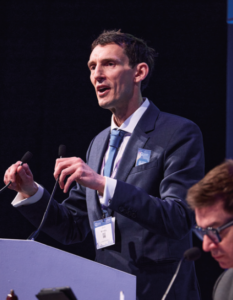
“Women with aortic aneurysms are more likely to die than men with aortic aneurysms.” This was the salient opening line of Colin Bicknell’s (Imperial College London, London, UK) presentation on the justification for the WARRIORS trial at the 2026 Charing Cross (CX) Symposium (21–23 April, London, UK).
“In elective repair, whether you do it with open repair or EVAR [endovascular aneurysm repair], in emergency repair, the risk of dying for a woman is about one and a half times that above the risk of dying for a man,” Bicknell continued.
The presenter pointed to a “brilliant” meta-analysis from fellow WARRIORS trial investigator Anna Pouncey (St George’s, University of London, London, UK) delving into the reasons behind this disparity in outcomes. “It is not the fact that these women are presenting later and with more illness, it may be, partly, because we’re treating women like men,” he summarised.
Bicknell highlighted the under-representation of women in “all of the aneurysm research that we know” and, with this in mind, stressed, “we need to have a think more about how we’re treating these women and how we can get some evidence”.
Summarising several datapoints on which WARRIORS is based, the presenter shared that, at 5.5cm aneurysm diameter, the rupture rate is “much higher” in women; 25% of women are turned down for surgery at 5.5cm or after they rupture; and at 5.5cm, fewer women are able to undergo EVAR. “The mortality and morbidity on top of that for open repair and FEVAR [fenestrated EVAR] is very high,” he added.
Against this backdrop of women being treated too late in their clinical course, Bicknell relayed the research question at the heart of the WARRIORS trial: can we minimise the disparity in outcomes for AAA between men and women by testing the theory that women will have improved outcomes if treated earlier than at present, for smaller diameter AAA and therefore at younger ages?
He continued that it is the researchers’ hypothesis that, in women with small AAA, early repair using EVAR compared to surveillance and repair as standard will reduce the incidence of AAA rupture and aneurysm-related mortality at five years.
Bicknell noted that the trial aims to enrol 1,112 women aged 50 and over with aneurysms of 4–5.5cm in diameter, with a primary outcome of AAA-related death and rupture.
Bicknell shared that WARRIORS has received Global Cardiovascular Research Funders Forum (GCRFF) endorsement and funding for several countries, including from the British Heart Foundation for the UK—the trial’s central site. He noted that over £8 million has been raised so far and that more than 20 countries are involved.
Bicknell ended his presentation with a nod to the foundational work of the late Janet Powell prior to her passing last year. “Janet Powell is the one that we’re all here for in this WARRIORS trial. She was the one that got together with all of these countries and negotiated. And it’s just thanks to hundreds of people in all of these sites around the world that we’ve got this going.”