This advertorial, sponsored by Gore, is only available in selected countries and geographies. [geoip-content country=”AT, BE, BG, HR, CY, CZ, DK, EE, FI, DE, GR, HU, IE, IT, LV, LT, LU, MT, NL, PL, PT, RO, SK, SI, CH, ES, SE, GB”]

“This is a milestone for arch repair,” Dittmar Böckler (Heidelberg, Germany) says of the first ever implantation of the Gore TAG thoracic branch endoprosthesis (TBE) in Europe. Böckler, who is chief of the Department of Vascular Surgery and Endovascular Surgery at University Hospital Heidelberg, performed the procedure on 30 January this year and here speaks with Vascular News about the wider significance of the device for patients requiring aortic arch treatment.
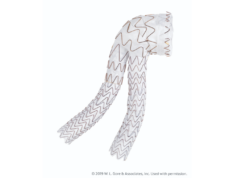
The Gore TAG thoracic branch endoprosthesis is indicated for endovascular repair of lesions in the descending thoracic aorta of patients with the appropriate anatomy, including isolated lesions, such as aneurysms, traumatic transections, and type B dissections, while maintaining flow into the left subclavian artery. “This is an off-the-shelf device, so there are no waiting times, for emergencies, within IFU [instructions for use],” Böckler states, underlining one of the key benefits of the Gore TAG TBE at a time when the majority of comparable devices are still custom made.
Rigorous in vitro and in vivo testing and extensive clinical trials have demonstrated the safety and performance of the device, paving the way for it to become the first endovascular graft for the aortic arch zone 2 to be granted both US Food and Drug Administration (FDA) and Medical Device Regulation (MDR) CE-mark approval.
“Treating aortic arch disease has traditionally posed challenges,” Böckler comments, by way of background. He states that current options involve procedures like open surgery, hybrid approaches with surgical revascularisation, or those that use non-CE mark devices. As a complete system including a dedicated arch-branch component, Böckler explains that the Gore TAG TBE “simplifies the treatment of zone 2 revascularisation by eliminating the need for surgical left subclavian artery debranching”. He continues: “The ability to endovascularly perfuse the left subclavian artery plays a key role in minimising surgical procedures and related risks.”
Giving a broad overview of the first European TBE case, Böckler shares that it was an elective procedure to treat an aneurysm of the distal arch. “Normally, we would treat a patient such as this either by overstenting the left subclavian artery or by doing a left carotid subclavian bypass,” he details. The Gore TAG TBE, however, offers a minimally invasive alternative for maintaining left subclavian artery patency. Böckler recalls that the procedure was “really very quick,” involving the creation of two percutaneous accesses—one brachial and the other transfemoral—followed by use of the “intuitive” Gore device. The whole process was completed within 60 minutes and the patient was back on the peripheral ward after four hours.

Böckler reports an “excellent” outcome, detailing that the procedure was “uneventful,” performed with minimal radiation, and completed in just one stage. “If you imagine that this case would have been performed in two stages, with a bypass and then in a second stage—or simultaneously—with a normal stent graft, that’s a much longer procedure, with longer anaesthesia time and longer postoperative surveillance time on ICU [intensive care unit],” he explains.
Böckler summarises the benefits this device might have on the treatment of aortic arch patients, including less anaesthesia, shorter procedure time, shorter recovery room time, shorter overall hospital stay, and fewer access problems. On this last point, he elaborates: “When you do carotid bypasses, you do a cutdown, you may end up with a nerve injury, you may end up with lymphatic problems, and these are gone with the Gore TAG TBE.” Böckler also predicts this off-the-shelf availability to be a “big advantage” in the future. “You will be able to use the device in emergencies when patients are unstable, and the device won’t cause additional access trauma or any other open surgery trauma,” he said.
In terms of clinical data, technical feasibility has already been proven. The pivotal study conducted in the USA enrolled 238 patients requiring treatment, including the left subclavian artery, across multiple aortic pathologies. All patients were enrolled with a technical success rate of 95.8%, reintervention rate of 2.9%, left subclavian artery branch patency of 99.2% and disabling stroke rate of 3.4% through 12 months of follow-up. Böckler does stress, however, that further data are needed. “Stroke rate is still an issue for any kind of endovascular procedure and of course also open surgery in the arch, so we will need prospective safety data,” he emphasises, for example. In addition to data on the associated stroke rate, Böckler adds that additional data on branch patency and the cost-effectiveness of the device would prove beneficial moving forward.
Long-term follow-up data are important too, Böckler points out. “Long-term durability of course cannot be answered in the next one or two years,” he says, “but we need long-term follow-up data to address the typical Achilles’ heel that is reintervention rate.”
Taking a step back from the specifics, Böckler underlines the fact that there is a “big demand” for the TBE device that is now closer than ever to being met. “There’s a big patient cohort out there that would really benefit from this device,” he says, which is one that offers an alternative for all the patients who might otherwise have to wait up to eight weeks for a customised device.
Böckler looks ahead to a forthcoming case that is planned at his centre. “The patient came in last week with some chest pain. We considered them to be symptomatic and they are now scheduled for treatment with the TBE device tomorrow, and I think he will benefit because he’s old—85 years old—so would not really be a good candidate for open repair and would not be able to wait six or eight weeks for a custom device,” Böckler shares.
“The Gore TAG TBE will fill a gap,” he summarises. “It will play a big role in our armamentarium and be complementary to the customised solutions. Also, I think it will reduce the need for physician-modified solutions.” Overall, Böckler is confident that the Gore TAG TBE “will increase the number of patients who are able to be treated—patients who would otherwise be refused treatment.”
[/geoip-content]