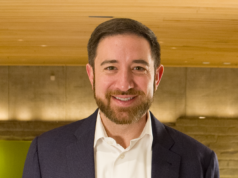
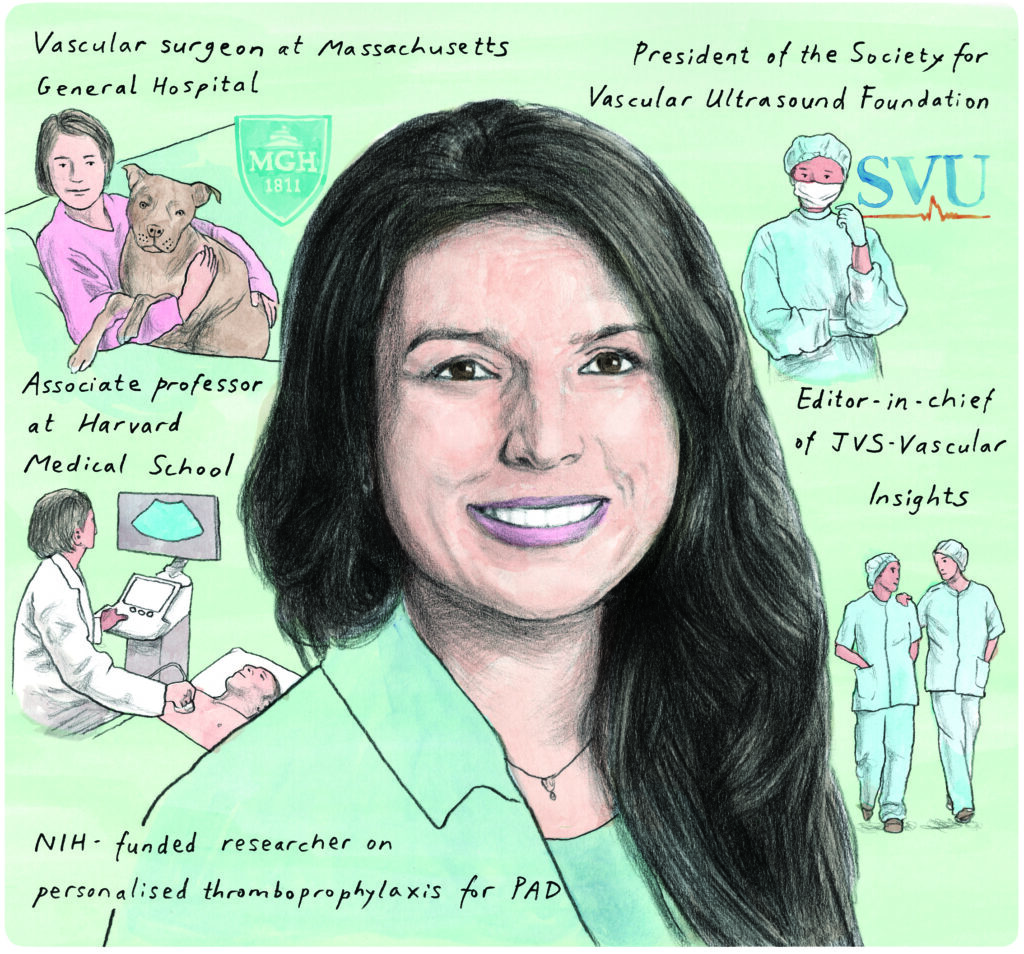
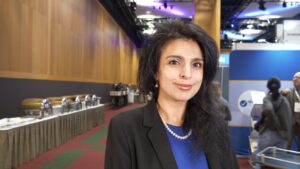
With interests ranging from precision medicine for peripheral arterial disease (PAD) to surgical outreach and political advocacy, Anahita Dua (Boston, USA) sees the boundaries of vascular surgery extend well beyond the operating room. Here, she speaks to Vascular News about her multifaceted and wide-ranging career in the specialty so far.
Why did you choose to pursue a career in medicine and subsequently specialise in vascular surgery?
I come from a family of doctors and so I was lucky to have been exposed to the honour and pleasure of taking care of patients from a very young age. There was a real privilege in having that exposure and feeling like what my parents were doing was really impacting people.
Growing up, I was open to exploring various career options—law, engineering, business—and I even have a business degree, but nothing ever reached the level of excitement that I felt about medicine. Something that came very close was space, but the engineering, the physics of it all, just didn’t appeal to me the way biology did.
In terms of vascular specifically, I saw during my training at the University of Aberdeen that, in vascular surgery, no two procedures are the same. It is the one specialty where every single day I am doing something very different and I have to snap in and out of what I’m thinking in order to be able to do the best for the patient at any given time. It’s very high stakes and I enjoy that.
Who were your career mentors and what was the best advice that they gave you?
I think that hundreds of people have mentored me in different ways over the course of my career so far; however, there are some names I must mention.
During my training, a gastroenterologist named Emad El-Omar was one of the first people to really believe that I was able to do something in research and do something in medicine. He, in conjunction with John Weigelt, who was a trauma surgeon at the Medical College of Wisconsin, launched my career into surgery.
John Holcomb, a trauma surgeon, and Charles Fox, a vascular surgeon, were also important mentors in the early stages of my career, as well as vascular surgeons Kellie Brown and Cheong Jun Lee.
When I went into vascular surgery, Jason Lee and Ron Dalman at Stanford were particularly influential. I must also mention Frank Veith and Enrico Ascher. While I’ve never operated with either one, both have demonstrated to me what it is to be a truly merit-based vascular surgeon. They represent the perfect combination of innovation and respect for history. The same goes for Roger Greenhalgh, who unfortunately I never met.
Simultaneously, several mentors have helped me to run my life in such a way that I have been able to pursue not only vascular surgery but various other endeavours, whether that has been running a political action committee that helps put doctors in office, co-founding a company that makes an aortic stent, or having a family.
You are involved in several areas of research, including on precision medicine for PAD. How did this work originate?
It all started back when I wanted to be a trauma surgeon. I went to do my postdoctoral research fellowship under John Holcomb, who at the time was doing research on something called thromboelastography, or TEG. This is basically a way to get a very quick idea of what your clotting mechanisms are during trauma surgery.
What is interesting in vascular, though, is that patients are dying not from bleeding, but from clotting. At this point, I wondered whether we could use the same precision technology to look at clotting profile.
When I came to Harvard, I got a grant from the National Institutes of Health (NIH) to explore this further. For every single human being on the planet, if they’re bleeding out, there is a ‘normal’ that they live at in terms of their clotting profile that needs to be maintained. We already know what that normal is; we all have the same level of platelets that should be functioning to be normal. Therefore, if a patient’s platelets are not at that level, then all the treating physician needs to do is get them to that normal.
The problem in vascular is that a patient is already ‘abnormal’ in this respect because when they are clotting, they need drugs to combat this, but just the right amount. That’s what we didn’t know—what that right amount is. That’s where my research came in, to properly identify that magic number.
The research revealed that 30% platelet inhibition is the magic number, where you don’t bleed and you don’t clot. Now I had a target to work towards with the drugs.
You have been working towards transforming care for people experiencing homelessness. Can you go into a bit of detail about this work?
We know that there are a lot of vascular patients who experience homelessness. We also know that, as a specialty, we have an inability to take care of vascular patients in one place at one time. A patient needs an ultrasound, then they need to come back and get their medications taken care of, then they might need a procedure, or wound care. My thinking behind the initiative was that people who can barely make one appointment for a variety of reasons are not going to be able to make 10 appointments.
I then came up with the idea that we bring all these elements of vascular care together in Mass General, in one place, in order to be able to treat vascular patients experiencing homelessness. I got the funding for it and we brought together every single element of vascular surgery and organised transportation for people who have been identified by primary care doctors in the community. We do the clinic once every three months on a Saturday and just treat anyone and everyone who needs care.
What do you think is the most important research frontier in vascular surgery at the moment?
I think a major medical advance that needs examining further in the vascular world is GLP-1s. We know that there are good effects and bad effects of these drugs, and the details remain to be seen, but their impact on vascular patients could be revolutionary.
What are the biggest challenges currently facing vascular surgery and what do you think can be done to address these?
On a micro level, it’s the fact that vascular surgery is the specialty that is going to be needed most in the future, and not enough people are going to be doing it. However, I think buried in that is the actual greatest thing that is affecting vascular surgery, which is the political landscape. Advances in innovation are fundamental to some of the things that we do, but if reimbursement doesn’t keep up, we can’t advance as a specialty.
I think the solution is that we need to be involved higher up. Not higher up from a leadership perspective, but higher up in the chain so that we can get to these patients earlier. The crisis is the ecosystem, and we need to insert ourselves into it more to achieve the outcomes that we want within the system.
What are your hobbies and interests outside of medicine?
A lot of the things I do outside of practising medicine all still relate to the field. I enjoy growing the aortic stent company I co-founded and being invovled in the political side of things. If I’m not working and I get a call about a rupture, I want to be there, I want to do it. I know it’s a little cliché, but it’s totally true. This is what I love.
Outside of vascular surgery and all the projects I’m involved in related to that though, I do a lot of animal rescue. I take care of animals that are sick that need a place to be for hospice care.
What advice would you give to someone looking to pursue a career in vascular surgery?
You don’t know what’s going to trigger your passion for something. I spent a lot of time with vascular patients and vascular surgeons and felt a sense that these were my people and ultimately the tribe that I wanted to be a part of. Vascular surgeons take care of the most vulnerable in society; these are elderly people, sometimes discarded by society. They might only have another year to live, but should anyone have to live 365 days with intense pain in their foot? No, and if I can do something to help, that gives me a real sense of purpose. Therefore, my advice would be: try vascular, try other things as well, expose yourself to different tribes, and you will know what’s right for you.