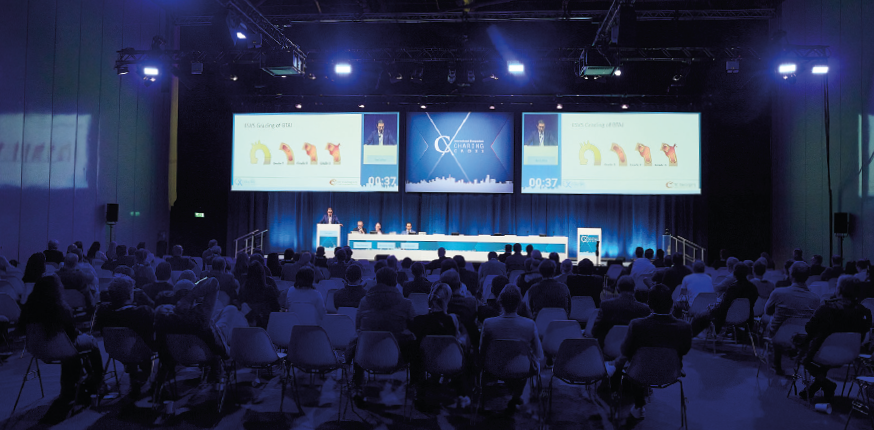
 The 48th Charing Cross (CX) Symposium (CX 2026; 21–23 April, London, UK) today opens its doors to vascular and endovascular specialists from around the world. Delegates can expect three days of education, innovation and evidence across all vascular domains with the aim of building consensus on the issues that matter most.
A global executive board led by co-chairs Dittmar Böckler (Heidelberg, Germany), Andrew Holden (Auckland, New Zealand) and Erin Murphy (Charlotte, USA) have assembled a programme designed to spark debate and discussion.
Aortic highlights include a full day of live and edited cases in a dedicated CX Aortic Live session, as well as seven debates and 14 podium-first presentations. Screening and new technologies in abdominal aortic aneurysm (AAA) repair will be discussed in depth, as well as updates on stroke, radiation and imaging, and new guidelines and registries.
“The aortic programme at CX 2026 has a lot of highlights to look forward to,” says Tilo Kölbel (Hamburg, Germany), executive board member for this year’s threeday aortic programme. “We made the first day on Tuesday [21 April] a CX Aortic Live day. We have live cases from Asia, from Europe and from very well-known operators.”
Late-breaking data and 34 podium-first presentations will be a feature of this year’s peripheral arterial and chronic limb-threatening ischaemia (CLTI) programme, which also spans the full three days of CX 2026.
Speaking to Vascular News, Holden remarks that day one of CX 2026 is “jam-packed with a lot of new data” in the peripheral arterial space, covering topics such as drug-coated balloons, bioresorbable scaffolds, and vessel preparation.
“On the third day [Thursday 23 April], we’re going to really dive deep into some new data from SWEDEPAD as well as obviously the BASIL trials and BESTCLI,” Holden continues. “So, lots to look forward to in the peripheral arterial programme.”
Another peripheral arterial programme highlight will be this year’s Roger Greenhalgh Memorial Lecture. Following in the footsteps of executive board member Gustavo Oderich (Houston, USA), who delivered last year’s inaugural address, Eric Secemsky (Boston, USA) will speak on 21st-century challenges in peripheral arterial disease (PAD) education, innovation and evidence on Thursday.
This year’s vascular access and renal interventions session, taking place today, will feature approaches to arteriovenous fistula (AVF) stenosis and a debate on whether innovation is dead in vascular access.
Meanwhile, tomorrow’s (Wednesday 22 April) carotid and acute stroke programme will feature several debates, including one titled ‘What do we believe: ECST-2 or CREST-2?’ following the longawaited publication of the CREST-2 trial results late last year.
Also taking place tomorrow, a series of presentations on pulmonary embolus management will open this year’s venous and lymphatic programme. Several talks on the latest data will feature, including from the STORM-PE, STRIKE-PE and HI-PEITHO trials.
The vascular trauma programme, scheduled for Thursday, will focus on evolving clinical practice using experience from vascular injuries in recent conflicts and features a debate on the motion ‘Limb salvage for blunt knee dislocation popliteal injury at 2am: Vein first’.
Elsewhere, the CX Innovation Showcase will feature a series of presentations on some of the latest technological developments in the vascular and endovascular world. The session, taking place on Thursday, will highlight innovations in the realms of peripheral arterial, aortic and venous disease, provide updates regarding imaging and artificial intelligence (AI) technologies, and feature the annual Dragons’ Den-style competition.