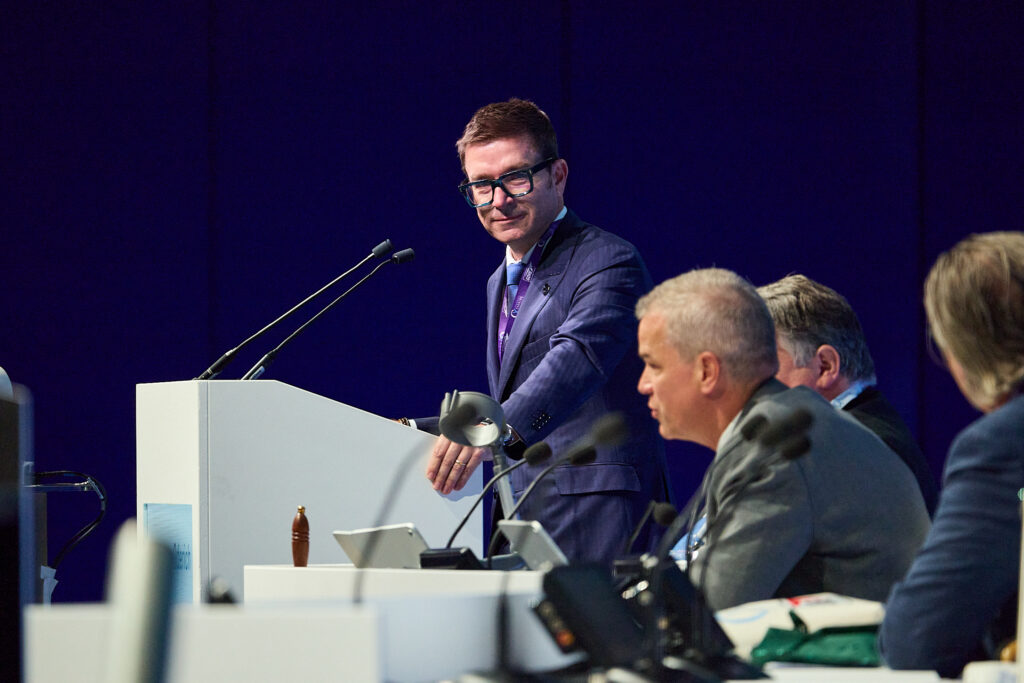
Gustavo Oderich (Houston, USA) previews an action-packed three days of aortic programming at this year’s Charing Cross (CX) Symposium (CX 2026; 21–23 April, London, UK), which spans the aorta, from the arch to the iliacs.
New and emerging techniques and technologies kick off this year’s CX aortic programme, with an edited case involving use of the “still experimental” endo-wheat procedure for type A aortic dissection among the standout presentations, according to Oderich, an executive board member for the symposium. Running over the course of Tuesday in Theatre 2, ‘CX Aortic Live: Aortic Techniques & Technologies’ features four sessions dedicated to dissection, thoracic and thoracoabdominal, juxtarenal and abdominal, and aortic arch concerns.
The edited case-heavy programming is “very much representative of common problems but also technical challenges we face,” Oderich says. “These illustrated cases are at the far end of the spectrum of complexity: we have, for example, laser septotomy, which is a technique that has been increasingly used for chronic dissection, as well as the endo-wheat technique for type A dissection, which is something still in the experimental phase but holds promise to really expand the field. Right now, there are only a few centres and operators doing this, and it is still in its infancy but is something we are going to continue to see.”
The aortic programme runs across all three days of CX, with Oderich hailing the diverse background and geographies of the assembled faculty. “That is important because endovascular technology evolves and it is not necessarily at the same pace in every region, which obliges surgeons to be very creative about how they are going to handle essentially the same problem we all have for patients,” says Oderich. “The programme pays attention to not only what is going on in Europe and the UK, but what is going on all over the world in terms of innovation in endovascular therapy in general.”
The CX Aortic Live session is masterminded by Tilo Kölbel (Hamburg, Germany), also a CX executive board member. “This is a very practical series of sessions for the audience to see how experts do the cases,” Oderich continues. The session also includes a look at endovascular therapy for genetic diseases during the dissection portion, as well as a number of different designs of devices and applications for thoracoabdominal aortic aneurysms (TAAAs). “That includes outer branches, inner branches, custom, off-the-shelf devices, but then also open surgery, which remains something that is indicated in small number of patients,” Oderich comments, highlighting an edited case involving a hybrid TAAA repair being given by Aung Ye Oo (London, UK).
In the juxtarenal and abdominal session, robotic surgery features in the form of two edited case from Marc Schermerhorn (Boston, USA) on lumbar ligation for sac expansion after endovascular aneurysm repair (EVAR), and Ross Milner (Chicago, USA), who will explore robotic vascular surgery as an alternative to open repair. Oderich says an edited case from Daniele Mascia (Milan, Italy) showing the use of a steerable sheaths for iliac branch devices promises something different from the traditional approach. Elsewhere, Stéphan Haulon (Paris, France) will be discussing the use of self-flaring bridging stents—“an important improvement in the area of fenestrated repair”, adds Oderich.
The techniques and technologies session concludes in the evening with a focus on the arch, which itself concludes with a presentation from Oderich on a case involving a custom three-vessel branch device for unusual anatomy. “It was an amazing case,” he explains. “I would consider it the case of the year for me. It was the first custom manufacture arch branch device by Gore, which has the off-the-shelf device TAG Thoracic Branch Endoprosthesis [TBE], but this was the first and only time they created a customised device with three branches. This was for a very unusual anatomy in a relatively young patient that I treated here in Houston about six months ago, and I’ll be presenting this for the first time at a large meeting.”
On Wednesday in Theatre 2, the aortic programme shifts gears to a focus on juxtarenal and abdominal aortic aneurysm (AAA) consensus. Physician-modified endografts (PMEGs) feature prominently, with Schermerhorn reappearing at the podium to talk about PMEGs through the prism of low-profile endografts. He will be followed by Michele Piazza (Padua, Italy), who will discuss an artificial intelligence (AI)-assisted standardised approach for a four-fen PMEG and outcomes from the SPHERE registry, then Maria Antonella Ruffino (Lugano, Switzerland), who will present on indications, planning and technical aspects in PMEGs for complex AAA based on a cross-sectional global survey. “PMEGs started off as a technique that was mostly used by surgeons who didn’t have access to any technology, which was the case in the United States for over a decade,” says Oderich. “It turns out that this technique found its niche even in Europe and other countries with earlier access to technology because it is very effective, and, in some patients, it is probably the best option when an off-the-shelf device is not ideally suited and they need an urgent repair.”
Later in the morning, a juxtarenal AAA debate between Nikolaos Tsilimparis (Munich, Germany) and Michel Bosiers (Bern, Switzerland) takes centre stage. They will be jousting over the proposition that off-the-shelf devices “are rarely justified and should be avoided” in juxtarenal AAAs, with the former arguing for the motion and the latter against. “We ask, in juxtarenal aneurysms—which need a less extensive coverage of the aorta—is it proper to use an off-the-shelf thoracoabdominal device, which automatically subject the patient to a more extensive coverage of the thoracic aorta, with its risks of spinal injury?” explains Oderich. “That fits perfectly the programme, because we will spend most of the morning talking about the importance of PMEGs, which would be the natural alternative to the off-the-shelf device. This will be a very interesting debate.”
The following AAA-focused session will see a lens placed over differences between repair in men and women, led off by Colin Bicknell (London, UK), who will deliver results from the WARRIORS trial. Screening, too, will feature, with Oderich highlighting how “the UK has led data on this since the 1990s, and there is some additional information about the effectiveness of screening that we will hear during the session”. At the end of the day, imaging and radiation risk will be addressed in a four-talk session. “I’m glad to see this because this should be a topic of review of any major meeting that addresses standard and complex endovascular repair,” Oderich remarks.
Meanwhile, on Thursday in Theatre 1, aortic programming focuses in on aortic arch, dissection and thoracic consensus. The first session of the morning, moderated by Kölbel and Haulon, leading experts of the field, looks at the aortic arch and stroke prevention. One of several debates of the day takes place in the thoracoabdominal portion, and will see Timothy Resch (Copenhagen, Denmark), arguing for, and Tomasz Jakimowicz (Warsaw, Poland), against, lock horns over the motion ‘Cone beam CT [computed tomography] should always be used in complex aortic repair and should always be performed’.