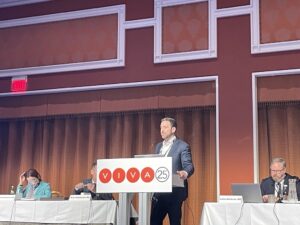
A focused session at the 2025 Vascular Interventional Advances (VIVA) conference (2–5 November, Las Vegas, USA) homed in on the latest findings from the SWEDEPAD registry-based randomised controlled trials (RCTs), with panellists discussing the results with reference to the wider evidence base on drug-coated device use in peripheral arterial disease (PAD).
Joakim Nordanstig (University of Gothenburg, Gothenburg, Sweden) opened proceedings with a summary of the SWEDEPAD results, which he and co-principal investigator Mårten Falkenberg (Sahlgrenska University Hospital and the University of Gothenburg, Gothenburg, Sweden) first shared at the 2025 European Society of Cardiology (ESC) congress (29 August–1 September, Madrid, Spain). Results were simultaneously published in The Lancet.
Nordanstig, who joined the session remotely, reiterated that drug-coated balloons and stents were not associated with reduced risk of amputation or improved quality of life compared with uncoated devices in the SWEDEPAD 1 and 2 trials of patients with chronic limb-threatening ischaemia (CLTI) and intermittent claudication, respectively. He added that higher five-year mortality with drug-coated devices in patients with intermittent claudication was noted.
Subsequently, Eric Secemsky (Beth Israel Deaconess Medical Center and Harvard Medical School, Boston, USA) took to the podium to consider the SWEDEPAD findings in the context of real-world data pointing to the contrary.
“Obviously, we have to take SWEDEPAD seriously because it’s a prospective trial,” Secemsky remarked, before stressing that clinicians “need to be thoughtful of all the other evidence we have to support the safety of paclitaxel”. Secemsky pointed to his and colleagues’ recently published and US Food and Drug Administration (FDA)-commissioned SAFE-PAD study among several others that demonstrate the safety of paclitaxel-coated devices.
Secemsky also questioned the relative importance of a mortality signal to the patient population in question. He highlighted data showing that, on average, patients would accept a device offering a reduction in two-year clinically driven target vessel revascularisation (CD-TVR) risk from 30% to 10% and a reduction in five-year CD-TVR risk from 40% to 30% if the five-year mortality risk increase was less than or equal to 4.6%.
On this note, Secemsky warned against a repeat of the reaction to the Katsanos meta-analysis from 2018, which saw a cutback in the use of paclitaxel devices. “It’s really critical for us to not get stuck where we were seven years ago,” he said, opining that “real patient harm” resulted from the Journal of the American Heart Association (JAHA)-published paper.
“The million-dollar question”
During a panel discussion following the two presentations, session co-moderator Joshua Beckman (UT Southwestern Medical Center, Dallas, USA) asked Nordanstig for his explanation of the mortality finding in SWEDEPAD 2.
“That is the million-dollar question,” Nordanstig replied, noting he was “very surprised” when he first saw the results.
Nordanstig recalled that the SWEDEPAD team published an unplanned interim analysis in 2020—in response to the paclitaxel safety discussion that arose following the publication of the Katsanos paper—which did not identify a mortality signal. He remarked that the signal in SWEDEPAD 2, however, is “hard to ignore” and that it would have been “impossible” not to raise concerns.
But Nordanstig was clear that discussion around SWEDEPAD should move away from the mortality signal and recentre around the trial’s primary findings. He professed to being “very concerned” that the SWEDEPAD team did not observe effectiveness of drug-coated devices for reducing limb amputations in SWEDEPAD 1. “In our dataset, it looks like we are postponing reinterventions rather than preventing them,” he said.
Secemsky focused on postponing reinterventions. “I wouldn’t minimise what postponing intervention means to patients,” he said. “In the USA, most of these patients are of low socioeconomic status, they don’t want to take time off work, so part of what we do is postpone. And we do this in the coronaries too. We use drug-eluting stents to postpone reinterventions and decrease them; sometimes we don’t use them to save lives or prevent bypass.”
“The patient needs to be first, and [postponing reinterventions] is a very patient-centric endpoint,” Secemsky stressed. Nordanstig agreed that “there is value in postponing interventions,” but also expressed concern that this did not translate to better limb salvage rates in SWEDEPAD 1.
Efficacy versus effectiveness
Later in the discussion, Beckman asked Nordanstig for his reaction to the “total dataset” on the efficacy and safety of paclitaxel.
“We need to be careful, and we need to look at the totality of evidence,” Nordanstig responded, before noting that the SWEDEPAD team is “planning further scrutiny of the evidence”.
Referencing a point made earlier in the session by Secemsky, Nordanstig stated that it would be informative to have data on cause-specific mortality available. “We have death causes in all patients from SWEDEPAD 1 and 2, so that is something we will look into,” he said. The presenter reiterated, however, that he is “more concerned about the lack of effectiveness [of drug-coated devices] than the mortality signal in SWEDEPAD 2”.
On effectiveness, session co-moderator Brian DeRubertis (New York-Presbyterian and Weill Cornell Medical Center, New York, USA) considered the patients with intermittent claudication in SWEDEPAD. “I’m wondering if there are aspects of the patients’ quality of life that are not captured by some of the metrics that we use,” he pondered. “Two patients in the same Rutherford Category can have vastly different experiences in terms of what they’re able to do on a day-to-day basis, so is it possible that some of the lack of effectiveness we see has to do with what we record in these patients’ experience?”
Nordanstig noted that, due to the pragmatic nature of the SWEDEPAD trial, the investigators had to work with the registry data that were available to them. However, he stressed that the VascuQoL-6 quality-life-life assessment used in SWEDEPAD 2 has been shown to closely correlate to everyday walking capacity, highlighting this as a relevant outcome measure for patients with claudication, while also acknowledging the test “might not show the full picture”.
Secemsky also commented on the limitations of quality of life as an endpoint. “The quality of life [in SWEDEPAD 2] is at one year, and there was about 42% stenting in this trial, so I’m worried that most people, if they get a stent, they’re probably going to be patent still at one year, which might wash out a little bit of the effect of difference,” he said.
Session panellist Iris Baumgartner (Bern Center for Vascular Medicine and Intervention, Vasc Alliance AG Angiology, Bern, Switzerland) questioned whether real-world use of drug-coated devices might explain the differing results between SWEDEPAD and the data from randomised controlled trials.
“This might be what is happening when you bring a technology that has been tested and proved during a very controlled experiment in a pivotal trial into a strategy trial on all patients, and we need to recognise that difference,” Nordanstig commented. “We did not control the research environment to the level that is usually done in a small, device-specific RCT, but I think it’s very important from a healthcare perspective and from a payer perspective to have these kind of trials that show effectiveness rather than efficacy and it might be that there are more and less experienced operators doing these procedures in over 3,500 patients, but I would not expect that this is not controlled for during randomisation.”