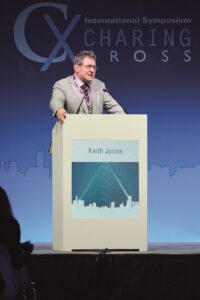
Vascular Society of Great Britain and Ireland (VSGBI) president Keith Jones (Camberley, UK) shares his thoughts on the SWHSI-2 trial results.
The SWHSI-2 trial results looking at surgical wound healing by secondary intention (SWHSI) in the UK were first presented by Ian Chetter (Hull York Medical School, University of Hull, Hull, UK) at the 2024 VSGBI annual scientific meeting (VSASM; 27–29 November, Brighton, UK). I, sat in the audience that day, was very impressed by the strength of the trial message but also very disappointed in the outcomes for these wounds that the trial highlights. The trial, which was published in The Lancet last summer, has been presented at other events, and it is interesting to see how it has been received.1 The authors explain that the majority of the 686 participants come from within vascular surgery and that the majority have diabetes and so it became a vascular surgery diabetic foot wound trial. Why this is interesting to me is that I chaired a debate at a multidisciplinary diabetic foot meeting between Chetter and a diabetologist who runs a foot clinic with the title ‘Negative pressure wound therapy does not add value in the management of diabetic foot wounds’.
As both chair and as a vascular surgeon with a significant interest in the management of vascular diabetic foot disease I expected only one outcome. As the results of this multicentre randomised controlled trial were presented, I felt the audience would be impressed by the quality of the trial itself with large patient numbers screened (1,895) and recruited (686), and the maintenance of those numbers through the 12 months of follow-up. I expected disappointment in reflection upon the poor outcomes of this wound cohort, with 42% unhealed at 12 months, 10% having amputations and 10% dying, which—as shocking as these outcomes are—I feel is a highlight for the trial since it clearly shows we must do better in the management of these wounds, potentially by improving the quality/extent of the debridement. Yet despite the clarity of the trial results, showing that negative wound pressure did not aid or speed up wound healing, the diabetic foot meeting audience still felt that negative pressure wound therapy (NPWT) added value to the management of diabetic foot wounds. This was a surprise since the results of the trial are clear on cost-effectiveness and very clearly imply that the findings do not support the use of NPWT to augment SWHSI healing. However, that vote did highlight the challenge of stopping the use of negative pressure, which we have utilised for more than 20 years, without evidenced protocols.
I would hope, however, that all who are interested in healing vascular diabetic foot wounds take the time to read the publication and, on reflecting on the results, see that we must get better at healing this wound group, whether that relates to the technique and quality of debridement, the enhancement of vascularity or the topical adjuncts used. What I see as a real strength of the trial is that it highlights the need for ongoing research in this area, to show how we enhance the wound healing of this group, because negative pressure is not the one-size-fits-all treatment it had been perceived to be.
I do expect negative pressure budgets to be cut, based on the trial evidence, but I do hope there is a next stage, where the research shows what does work. But for the moment I would congratulate the authors on an excellent trial and its challenging results.
References
- Arundel C, Mandelfield L, Fairhurst C, et al. Negative pressure wound therapy versus usual care in patients with surgical wound healing by secondary intention in the UK (SWHSI-2): an open-label, multicentre, parallelgroup, randomised controlled trial. The Lancet. 2025; 405(10490): 1689–1699.
Keith G Jones is a consultant vascular surgeon at Frimley Health NHS Foundation Trust in Camberley, UK.