This advertorial, sponsored by Gore, is only available in selected countries and geographies. [geoip-content not_country=”US”]
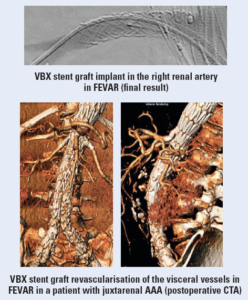
Two Gore-sponsored registries are evaluating the performance of the company’s Viabahn VBX balloon-expandable endoprosthesis (VBX stent graft) in fenestrated and branched endovascular aneurysm repair (F/BEVAR). With data from 371 patients across 29 European centres, the CE-marked bridging stent has demonstrated safety and performance out to midterm follow-up in hundreds of procedures within the EXPAND and EMBRACE studies, as outlined here by investigators Mauro Gargiulo (University of Bologna, Bologna, Italy) and Luca Bertoglio (University of Brescia, Brescia, Italy).
Gargiulo, principal investigator of EXPAND, first explains that the use of fenestrated and branched technologies is a core component of aortic specialists’ daily practice for the treatment of both urgent and elective aortic aneurysm, specifying their use in juxtarenal, pararenal, and thoracoabdominal aortic pathologies.
In recent years, stent graft technology for these procedures has “progressed rapidly”, adds Bertoglio, who is coordinating investigator of the EMBRACE registry. Gore has been one of the companies at the centre of this advancement, with the VBX stent graft CE marked for both FEVAR and BEVAR since 2025.
Furthermore, these complex repairs now have guideline backing, with Bertoglio referencing the new 2026 document from the European Society for Vascular Surgery (ESVS) and its suggestion that F/BEVAR should be considered a “first option” for the treatment of thoracoabdominal aortic aneurysms.
Against this backdrop, the EXPAND and EMBRACE registries have been designed to confirm the safety and efficacy of the VBX stent graft in a real-world patient population.
EXPAND is a postmarket registry evaluating the safety and performance of the VBX stent graft in peripheral vessels, including a cohort of patients treated for F/BEVAR. EMBRACE, meanwhile, is a multicentre, single-arm retrospective and prospective registry aiming to confirm the clinical performance and safety of the VBX stent graft for F/BEVAR in the treatment of aortic aneurysms involving the renal-mesenteric arteries.
Midterm data now available
Three-year data from EXPAND and one-year data from EMBRACE have been presented at several major congresses, including the 2025 Charing Cross (CX) Symposium (23–25 April, London, UK), with publications expected shortly. Data out to five and three years, respectively, are set to be shared this year.
Reporting the latest results from the EXPAND registry, Gargiulo first provides some details on the 112 patients included in the study. Focusing on the fenestrated cohort, he notes that the majority of these patients were treated for either a juxtarenal or pararenal aneurysm, with around 30% treated for a thoracoabdominal aortic aneurysm. “We had a fantastic result regarding technical success,” Gargiulo shares. “We had 100% technical success, and, regarding the patency of this stent graft, at three years follow-up [it] was more than 96%.”
Gargiulo comments that these are “very important results for our daily practice in the endovascular treatment of aortic aneurysmal disease with involvement of the visceral vessels”. He cites the significance of renal artery and superior mesenteric artery (SMA) patency in particular. “If we have an occlusion of the renal arteries, we have the risk of dialysis for our patients. And the same for the SMA—it is very important to have a stent graft with this very high percentage of patency because we know very well that if we have an occlusion of the SMA, we have the risk of patient death.”
As for the BEVAR cohort of the EXPAND registry, Gargiulo shares similarly positive results. “Again, in this subgroup of patients, we had some patients with juxtarenal and pararenal aneurysms, but the majority were patients with thoracoabdominal aortic aneurysms,” he says, going on to share a technical success rate of 100% and rates of freedom from stent-related death and freedom from procedure-related death at 30 days of 100% and 97%, respectively.
“This is very important for the role of [the VBX stent graft] in our daily practice, when we have to treat patients with thoracoabdominal aortic extension or pararenal or juxtarenal extension,” Gargiulo remarks.
On EMBRACE, Bertoglio comments that the one-year data from the 259 patients included in this registry are “highly satisfactory”. He explains: “The primary patency is up to 98% for BEVAR and the freedom from target vessel instability is up to 94%.” Hinting at what clinicians can expect from the upcoming three-year results, Bertoglio points to further positive outcomes. “Basically, the three-year results are continuing on the same path. We don’t have any drop in the results.”
As for the FEVAR results, Bertoglio reveals that the data are “very strong” for this cohort too. In fact, he says, “they are even better,” which is “expected because FEVARs in general have more benign results in terms of performance”. Specifically, Bertoglio underlines a primary patency rate of up to 99% and freedom from target vessel instability of up to 95%.
Scientific support for daily practice
In terms of future data, Gargiulo is keen to stress that the final endpoint for EXPAND is the fiveyear follow-up mark. “I think that five-year follow-up is very important and fundamental for the study, because we must guarantee long-term results for these patients with complex abdominal aortic disease and thoracoabdominal aortic aneurysms and we must clearly define the role of VBX in FEVAR and BEVAR in the revascularisation of visceral vessels over the long term,” he says. As for what’s next for EMBRACE, Bertoglio highlights that the specifics of the three-year results—already showing continued positive outcomes for the VBX stent graft—will soon be revealed.
Summarising, Gargiulo and Bertoglio are in agreement that having an on-label bridging stent—backed by robust clinical evidence— empowers healthcare professionals to deliver optimal patient care with a focus on better long-term outcomes.
“I think that we need these important results because, for us as clinicians, this is scientific support for our daily practice,” says Gargiulo.
Bertoglio reiterates that the on-label F/BEVAR indication for the VBX stent graft was a “landmark” event in the history of complex aortic repair and that the available data add further support for use of the device in complex aortic anatomies. “EMBRACE and EXPAND have gathered the data to support that [on-label indication] for the VBX,” he says.
References
- Usai MV, Gargiulo M, Haulon S, et al. A three-year experience with the balloon expandable GORE VIABAHN VBX in the treatment of thoraco-abdominal aortic aneurysms within the EXPAND trial. J Vasc Surg. 2025 Feb;81(2):319-323. e1. doi: https://doi.org/10.1016/j.jvs.2024.10.002
- W. L. Gore & Associates. Post-Market Registry of the GORE® VIABAHN® VBX Balloon Expandable Endoprosthesis Implanted in Peripheral Vessels (EXPAND). VBX 17-04. https://clinicaltrials.gov/study/NCT03720704
- W. L. Gore & Associates. Real-World Data Collection of the GORE® VIABAHN® VBX Balloon Expandable Endoprosthesis When Used as a Bridging Stent with Branched and Fenestrated Endografts in the Treatment of Aortic Aneurysms Involving the Renal-Mesenteric Arteries (EMBRACE). VBX 21-04. https://clinicaltrials.gov/study/ NCT05143138
IFU note: Refer to Instructions for Use at eifu.goremedical.com for a complete description of all applicable indications, warnings, precautions and contraindications for the markets where this product is available.
[/geoip-content]