
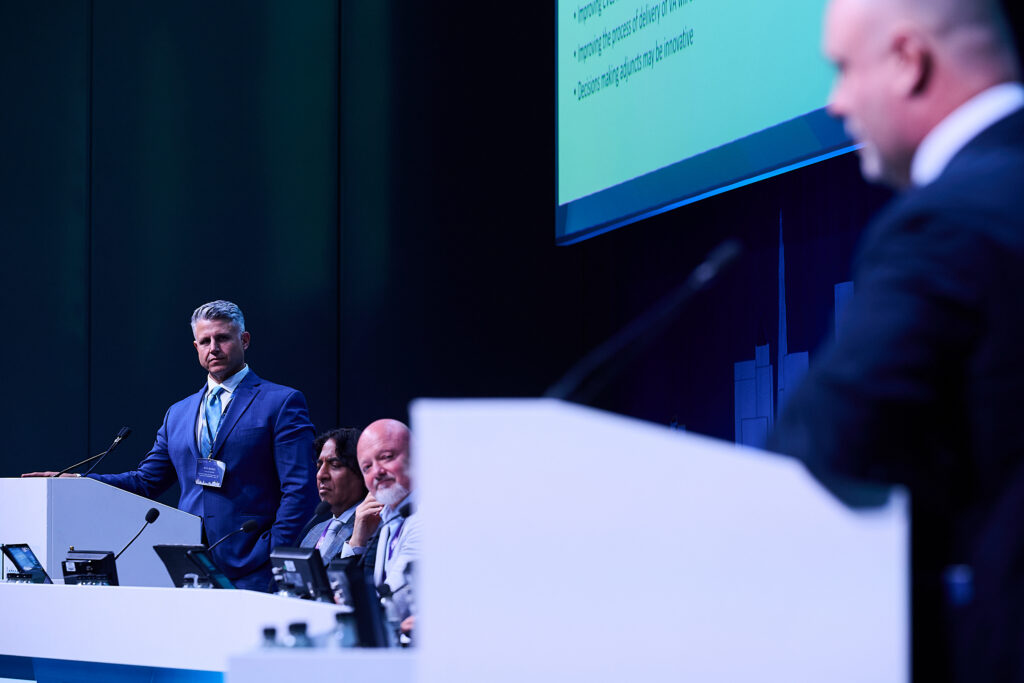
Innovation is dead in vascular access. That was the unenviable challenge Nicholas Inston (Birmingham, UK) took on at the 2026 Charing Cross (CX) Symposium (21–23 April, London, UK). He wasn’t exactly convinced by the flavour of his side of the debate anyway. “Hopefully I’m going to get proven wrong here,” Inston opened. He asked how many believe in the motion, calling for a show of hands. “One person,” he remarked wryly, from a packed room. “I’m really up against it here, aren’t I?”
He rattled through 50 years of haemodialysis history, “yet access remains the Achilles’ heel”. “And our best solution, now in 2026, it is still the fistula that was first described in 1966.” The results of that study had an 85% patency, and “we’ve just gone downhill”. Problems have abounded, “failure to mature, thrombosis, dysfunction” and so on.
“Innovation is not just an idea,” Inston said. It’s more than an idea and an invention, he said, “but it’s actually making that idea have a difference to what we’re trying to do”. Adopting that idea into the clinical field and then “creating value from that adoption”. “Innovations” have come along, the fistula, ePTFE, biological grafts. Some have simply come and gone, he added. There have been great ideas, but have they been great innovations? They might work, “but are they innovations? Because they have not been widely adopted,” Inston added.
“I don’t think devices are going to be where the innovation’s at; it’s going to be perhaps improving central venous catheter outcomes … but I think the innovation in the device field is probably dead.”
On the other side, Anthony Rodriguez (Austin, USA) weighed in with a two-footed tackle from the kick-off: “That was probably the best job you could have done,” he began. “I’m in a lose situation here, because everybody already agrees with me, I can’t change anybody’s mind. It’s going to change one person, and that’s one of the problems with innovation.”
Inston hails from the specialist side, and Rodriguez from the device development side. When he saw Inston up on the other side of the debate argument, Rodriguez said he jumped at the opportunity. While unorthodox to see a member of industry at the podium in such a guise, the programme committee sanctioned the participation.
Innovation takes an extremely long time, more than a century through a range of advances to reach the point of chronic haemodialysis. “From there we saw some things heating,” Rodriguez said. More advances came before the first dialysis centre appeared in 1962, he added. “Then a fistula, a graft, and then we have this long drought, 40 years while saying innovation was dead.” By 2007, “we finally had the first device in a long time that was specifically designed for AV [arteriovenous] access”, he said. That’s now little talked about, “because innovation is also iterative”. That has yielded further progress, cycling forward to “really getting innovation really around, how we are going to solve these problems that started to get defined in the early 2000s”, said Rodriguez. Then came endoAVF—“and that’s why you see today multiple devices … new innovations that have all come out, and all because of new iterations”.
Ultimately, Inston proved Rodriguez’s point by clawing back some support for his motion.









One of the main reasons for poor outcomes in clinical trials is the lack of robust biological models that adequately explain failure and capture the key processes driving venous remodeling after AVF or AVG creation. Clinical research has been slow to incorporate innovation from the basic science arena. Greater integration between clinicians and basic scientists is essential to develop more realistic, human-centered models of vascular access failure. Continuing to design clinical trials based on assumptions rather than mechanistic understanding will likely result in continued failure.