This advertorial, sponsored by Boston Scientific, is only available in selected countries and geographies. [geoip-content not_country=”US”]

Based on several years of clinical experience and extensive published data, including a recent meta-analysis of proportions, Sabine Steiner (Medical University Vienna, Vienna, Austria) shares her insights on the role of the Eluvia drug-eluting stent (DES; Boston Scientific) in peripheral arterial disease (PAD) treatment.
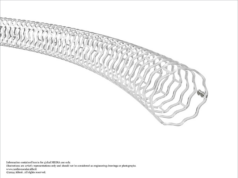
Launched in Europe in 2016 and the USA two years later following successful results from the IMPERIAL randomised controlled trial (RCT),1 the Eluvia DES is designed to provide sustained drug release and efficient drug transfer with the aim of overcoming the challenge of restenosis in the superficial femoral artery (SFA).
Steiner’s clinical experience with the Eluvia DES dates back several years. At this time, she and colleagues conducted the BEST-SFA RCT, in which Eluvia was used as a comparator. “What we observed in this analysis, and in our own clinical experience, was that the stent performed very well, effectively inhibiting the need for reintervention.” Steiner recalls. Two-year results of this study were published in 2024 in JACC: Cardiovascular Interventions.2
On the specifics of Eluvia’s design, Steiner remarks that the availability of a 15cm-length stent is a “major advantage”, noting that it allows coverage of numerous lesions while maintaining excellent outcomes and durable patency rates.
What’s more, Steiner’s confidence in the device is boosted by medical society backing. “Drug-eluting therapies are clearly recommended by guidelines for femoropopliteal disease, for example from the European Society of Cardiology,” she notes. “And we know in general that there’s a benefit of drug elution with respect to patency and reinterventions.”
As a result, in cases where Steiner sees the need for stenting after vessel preparation and predilatation, Eluvia is her first choice. Caveating this by noting an overarching aim to avoid stenting in the SFA where possible, especially in claudicants, Steiner does highlight a “substantial” proportion of patients will need stenting. “In many standard cases where stenting is necessary, Eluvia DES is my preferred option,” she says.
Superior primary patency and TLR
Some of the latest data on the Eluvia DES can be drawn from a recent meta-analysis, the results of which were presented by Andrew Holden (Auckland City Hospital and University of Auckland, Auckland, New Zealand) at the 2025 Charing Cross (CX) Symposium (23–25 April, London, UK) and recently published in the Journal of Comparative Clinical Effectiveness.3,4 This study is a systematic review and meta-analysis of proportions including Eluvia as one of several comparators to bare metal stents, with outcomes assessed at 12 and 24 months.
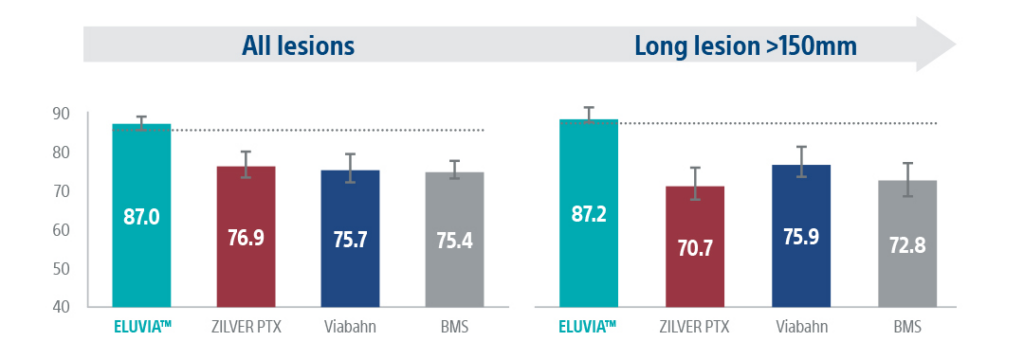
In this analysis, the Eluvia DES demonstrated greater primary patency and freedom from target-lesion revascularisation (TLR) outcomes at both timepoints compared to all other stent types, with no difference in mortality rates. Specifically, based on data from 3,063 patients across 17 studies, primary patency with Eluvia was 87% at 12 months; at 24 months, the corresponding figure was 77.9% (2,065 patients, nine studies). The rate of TLR was 7.3% at 12 months (2,892 patients, 14 studies) and 14.2% at 24 months (1,864 patients, eight studies).
Steiner, who is a co-author of the meta-analysis, shares her take on the findings. “We see consistent results with respect to very good data for primary patency and TLR rates over one and two years,” she notes.
Unique findings in longer lesions
Going into more detail, Steiner notes a “striking” finding from the meta-analysis in that Eluvia shows a consistent benefit in both short and long lesions, with the latter referring to those of at least 15cm in length. “I think this is a crucial point,” she comments.
“This is quite a unique finding,” Steiner continues, “because we know that longer lesions in general have slightly worse outcomes, or at least more events during the follow-up period. So, I think that it’s very reassuring that also in longer lesions, Eluvia really worked very well.”
Steiner notes that mortality rates for short lesions were stable across all stent types, but more variable for long lesions. More generally, she remarks that the mortality signal that has been associated with drug-eluting therapies “is not very realistic”. She explains: “I believe this is largely driven by chance and the relatively small sample sizes. Moreover, the observed signal does not suggest a true excess risk, but rather an early imbalance of events, as the survival curves converge over time. So, I personally don’t have concerns regarding mortality associated with any drug-eluting therapy.”
Summarising her key take-home messages from the meta-analysis, and making particular reference to the relevance of the follow-up period, Steiner shares: “In these first two years, when neointimal hyperplasia and vascular response to injury are most pronounced, we see better results with the Eluvia stent compared to all other stent types.”
“From a longer-term perspective, disease progression is to be expected,” Steiner acknowledges, looking ahead, “However, this likely reflects the natural history of peripheral arterial disease.” Within the present follow-up period, however, she still considers the results “impressive”.
Steiner does recognise a limitation in that there was “very inconsistent reporting of outcomes” across the over 140 trials included in the analysis. In addition, she notes that a relatively low percentage of studies included information on core lab-adjudicated outcomes. “This underscores the heterogeneity in reporting standards across studies,” she comments, “which is a clear concern. Improving the consistency, quality, and standardization of outcome reporting should be a priority for future trials.”
Overall, Steiner remarks that the Eluvia DES is a stent that is user-friendly, with favourable deliverability and precise placement characteristics. She highlights its availability in a convenient 15cm length and reports consistently good primary patency and target lesion revascularisation rates through two years, including in longer lesions.
References
- Gray WA, Keirse K, Soga Y, et al. A polymer-coated, paclitaxel-eluting stent (Eluvia) versus a polymer-free, paclitaxel-coated stent (Zilver PTX) for endovascular femoropopliteal intervention (IMPERIAL): a randomised, non-inferiority trial. The Lancet. 2018;392(10157);1541–1551.
- Wittig T, Schmidt A, Fuβ T, et al. Randomized trial comparing a stent-avoiding with a stent-preferred strategy in complex femoropopliteal lesions. JACC: Cardiovascular Interventions. 2024;17(9):1134–1144.
- Holden, A. Performance of Stenting in Femoropopliteal Disease: Systematic Literature Review and Meta-analysis of Proportions. Presented at Charing Cross 2025.
- Gouëffic Y, Bosworth Smith A, Distler F, et al. Performance of stenting in femoropopliteal disease: a systematic literature review and meta-analysis of proportions. Journal of Comparative Clinical Effectiveness. 2026;15(4).
[/geoip-content]