This advertorial is sponsored by Shape Memory Medical.
 The field of embolisation has seen an increasing number of devices enter the market, raising an important question: how much does the choice of embolic device influence outcomes? The Impede embolisation plug (Shape Memory Medical), comprised of a shape memory polymer (SMP), or smart polymer, has garnered significant attention in recent years, appearing frequently in the scientific and clinical discourse. To better understand what differentiates this technology, Vascular News spoke with two of the scientists driving its development—Marziya Hasan and Landon Nash—who both hold PhDs from Texas A&M University (College Station, USA).
Background
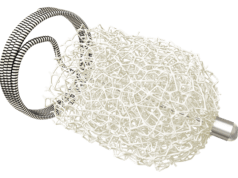
SMP has emerged as a novel material and is currently employed in the Impede embolisation plug family of devices, indicated for peripheral vascular embolisation. These devices incorporate Shape Memory Medical’s proprietary polymer—a porous, radiolucent material which allows for enhanced visualisation of the surrounding anatomy during and after the procedure. Crimped for catheter introduction, the polymer self-expands to its original shape upon contact with the warm, aqueous environment of the blood vessel. This expansion creates a conformable, high-volume fill that facilitates stable thrombus formation and rapid, durable occlusion.
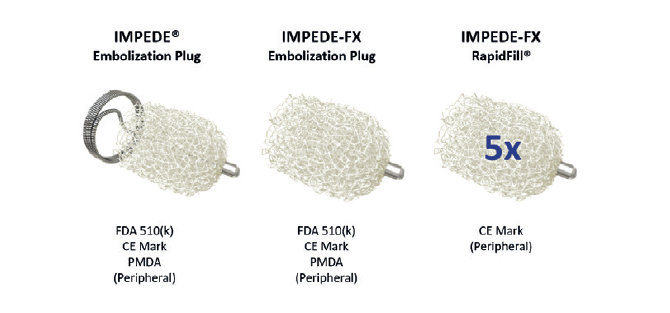
The Impede embolisation plug family is commercially available in more than 30 countries across Asia, the Middle East, Europe, the Americas, and Australia, reflecting its growing global adoption. Recently, Shape Memory Medical announced the completion of the EMBO-postmarket surveillance registry, a prospective, multicentre study evaluating real-world outcomes with the Impede and Impede-FX embolisation plugs as well as the Impede-FX RapidFill device in peripheral vascular embolisation.
What distinguishes the chemistry of shape memory polymer?
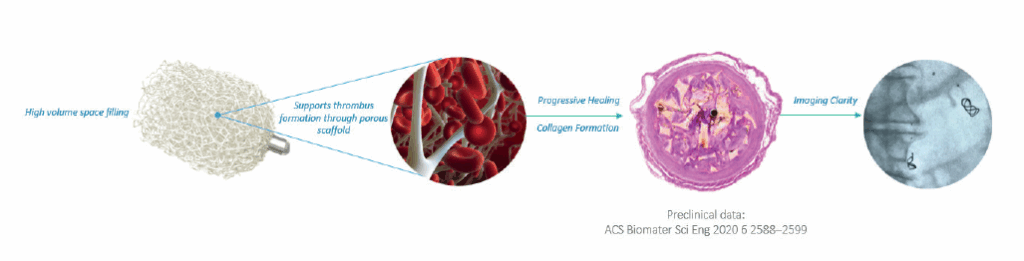
MH and LN: Shape Memory Medical’s proprietary polymer is an ultra-low-density, bioresorbable polyurethane foam engineered with high volume recovery. The material is manufactured in an expanded state and subsequently crimped to allow catheter-based delivery. Once deployed, it returns to its original form, enabling high-volume space filling. While polyurethanes are widely used in blood-contacting medical devices, the use of a bioresorbable polyurethane in this context represents a novel approach not commonly seen in commercially available embolic technologies.
How does shape memory polymer differ from other polymer technology in terms of its bioresorbability?
MH and LN: The bioresorption of SMP is driven by a cell-mediated mechanism rather than the more common hydrolytic pathway. The polymer network is designed to degrade at specific functional net points under oxidative conditions.1 This occurs through the action of reactive oxygen species (ROS) produced by macrophages—immune cells that play a central role in clearing foreign materials. In this setting, macrophage-generated ROS initiate the breakdown of the polymer, leading to gradual bioresorption.
By contrast, many commercially available bioresorbable materials rely on hydrolytic degradation. For example, ester-based polymers degrade in the presence of water, generating carboxylic acids that lower local pH and accelerate breakdown. This hydrolysis-driven mechanism is largely passive, whereas SMP’s cellmediated oxidative degradation represents a more active and biologically responsive process.
What is the effect of bioresorption of occlusion durability?
MH and LN: The bioresorption of SMP occurs gradually, based on preclinical in vivo studies.2,3 Importantly, as the polymer resorbs, it is replaced by the body’s own native tissue. During this process, myofibroblasts actively deposit collagen—a type of scar tissue—ensuring that the initial scaffold progressively remodels rather than leaving voids.
This mechanism distinguishes SMP from hydrolytically degradable polymers, as SMP degrades in direct response to the body’s immune and healing processes. It is only resorbed when cells actively remodel the implant site, with the polymer acting as a temporary scaffold that transitions to durable, collagenous connective tissue.
Preclinical studies have further demonstrated that SMP is biocompatible.3 Rather than compromising durability, the material supports a natural healing response that stabilises the site over time.
Clinically, the initial prospective safety study on the Impede embolisation plug evaluated 10 patients undergoing peripheral vascular embolisation. Long-term imaging follow-up in this cohort demonstrated no evidence of recanalisation, underscoring the device’s durable embolic performance.4
Is an inflammatory response associated with SMPs and other polymers?
MH and LN: Yes. Immune cells recognise and respond to all foreign materials introduced into the body, but the severity and duration of the tissue response is dependent on many chemical and physical factors unique to every device, the materials of construction, and targeted therapeutic use.5
For example, embolic devices composed of platinum are comparatively biologically inert. In some cases, they may not generate a sufficient signal to fully activate the body’s healing cascade. In contrast, a transient inflammatory response can be beneficial serving as a signal to initiate tissue repair. The critical factor is ensuring that this inflammation resolves quickly, allowing the implant site to transition smoothly from the acute inflammation phase to longterm healing.
Conclusion
Preclinical and clinical experience to date has demonstrated the unique biological response of shape memory polymer, the material used in the Impede embolisation plug family of devices, which facilitates stable clot formation, supports remodelling, undergoes gradual bioresorption, and is ultimately replaced with organised collagen scar tissue. This tissue response not only stabilises the implant site but may also influence long-term vessel remodelling.
Building on this foundation, Shape Memory Medical is advancing the AAA-SHAPE investigational device exemption (IDE) trial—a prospective, multicentre, randomised, open-label study designed to evaluate whether the Impede-FX RapidFill device can improve aneurysm sac behaviour and potentially enhance rates of aneurysm shrinkage when used alongside elective endovascular aneurysm repair (EVAR). Enrolment is underway and will continue through 2025.
Looking further ahead, the company is also exploring novel applications, and developing a large-diameter device comprised of SMP specifically engineered for false lumen embolisation in aortic dissection. These efforts underscore a broader vision: harnessing biomaterials that actively engage the body’s biological response to shape the future of embolisation therapy.
 Disclaimers: The Impede and Impede-FX embolisation plugs and Impede-FX RapidFill are CE-mark approved. The Impede and Impede-FX embolisation plugs are approved in Japan and cleared for use in the USA. In the USA, the Impede embolisation plug is indicated to obstruct or reduce the rate of blood flow in the peripheral vasculature, and the Impede-FX embolisation plug is indicated for use with the Impede embolisation plug to obstruct or reduce the rate of blood flow in the peripheral vasculature. In the USA, Impede-FX RapidFill is an investigational device, limited by Federal (or US) law to investigational use. For more information, visit www.shapemem.com.
References
- Weems AC et al. Shape memory polyurethanes with oxidation-induced degradation: In vivo and in vitro correlations for endovascular material applications. Acta Biomater. 2017 Sep 1; 59: 33–44.
- Horn J et al. Comparison of shape memory polymer foam versus bare metal coil treatments in an in vivo porcine sidewall aneurysm model. J Biomed Mater Res B Appl Biomater. 2017 Oct; 105(7): 1892–1905.
- Jessen SL et al. Microscopic assessment of healing and effectiveness of a foam-based peripheral occlusion device. ACS Biomater Sci Eng. 2020 May 11; 6(5): 2588–2599.
- Holden A, Hill AA, Buckley BT. Shape memory polymer technology in peripheral vascular embolization. Vascular. 2024 Oct; 32(5): 1137–1142. 5. Anderson JM, Rodriguez A, Chang DT. Foreign body reaction to biomaterials. Semin Immunol. 2008 Apr; 20(2):86–100.