
Shape Memory Medical today announced enrolment of the first patients in FLAGSHIP, the company’s prospective, single‑arm, open‑label first‑in‑human study evaluating its investigational false lumen embolisation (FLE) system for the treatment of aortic dissection.
FLAGSHIP is designed to evaluate safety and preliminary signs of efficacy of the FLE system for treatment of aortic dissection false lumen. The study will enrol up to 30 patients with follow-up through two years.
The first two procedures were performed at Auckland City Hospital in Auckland, New Zealand, by Andrew Holden, principal investigator, and Anastasia Dean. A second New Zealand site—Waikato Hospital in Hamilton—has been activated under the leadership of Manar Khashram.
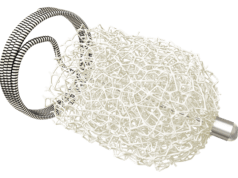
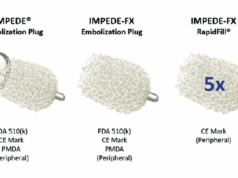
Shape Memory notes in a press release that the FLE system, which is purpose-built for embolisation of an aortic dissection false lumen, represents a “significant advancement” in volumetric embolisation compared to the company’s commercially available Impede embolisation plug family. Investigational models include 18mm, 24mm, and 36mm diameters (when implant is fully expanded), and single and multi-segment configurations.
According to Shape Memory, the largest-volume FLE system implant delivers approximately 76 times the volume of the company’s largest commercially available plug, enabling treatment of a variety of false lumen sizes.
Like the Impede platform, the FLE system utilises Shape Memory’s proprietary porous shape memory polymer scaffold, delivered via catheter in a compressed form and self-expanding upon contact with blood. The scaffold is engineered to promote organised thrombus formation while conforming to irregular anatomy and maintaining radiolucency to minimise imaging artifact.
“We are excited to participate in the FLAGSHIP study,” said Holden. “Persistent false lumen perfusion remains one of the most significant predictors of adverse outcomes in aortic dissection. A dedicated technology designed to thrombose the false lumen and support positive remodelling alongside TEVAR [thoracic endovascular aortic repair] has the potential to address a significant unmet clinical need.”