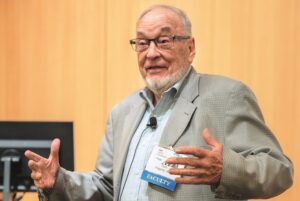
 Thomas J Fogarty, the world-renowned cardiovascular surgeon, innovator and inventor of the Fogarty catheter, died peacefully on 28 December 2025 at the age of 91.
Colleagues at Fogarty Innovation, a nonprofit educational incubator dedicated to advancing medical innovation, announced the news of their founder’s passing. “We are immensely grateful for all Tom did for patient care, for the medtech innovation ecosystem, and for so many of us personally—as a leader, a mentor, and a friend,” the statement reads. “His relentless curiosity, refusal to accept the status quo, and boundless imagination reshaped the field and continue to inspire generations of innovators. We will miss him more than we can say.”
Born on 25 February 1934 in Cincinnati, USA, Fogarty was a keen inventor from an early age. One of his first creations was the centrifugal clutch, which was taken up by Cushman motors and is a technology that is still used today. Boxing was another passion, and one Fogarty had early ambitions to pursue professionally before medicine became his chosen career path.
As a teenager, Fogarty took on a job as an orderly at the Good Samaritan Hospital in Cincinnati that piqued his interest in a medical career. “I was able to get to know the doctors and became interested in what they did,” he told Vascular News in a profile interview from 2006, referencing vascular surgeon Jack Cranley as an important mentor from this point onwards.
In 1956, Fogarty graduated with a BS in biology from Xavier University in Cincinnati and subsequently from medical school—the University of Cincinnati College of Medicine—in 1960.
Fogarty undertook cardiovascular surgery training at the University of Oregon Medical School (Portland, USA), the Good Samaritan Hospital, and Stanford University Medical Center (Stanford, USA), where he later began teaching in the 1970s. In 1980, he became the director of cardiovascular surgery at Sequoia Hospital in Redwood City, USA, and, in the early 1990s, professor of surgery at Stanford University Medical Center. Fogarty also held a private practice while living in California.
In his 2006 interview with Vascular News, Fogarty highlighted the challenging technical nature of cardiovascular surgery as a key reason behind his pursuit of a career in the specialty. “It takes a more focused approach and complete understanding of pathophysiology,” he said at the time.
Fogarty is well known as the inventor of the eponymously named balloon embolectomy catheter, as well as several other innovations including the Hancock tissue heart valve and the AneuRx endovascular aortic stent graft.
“The balloon catheter was invented while I was in medical school,” he told Vascular News in 2006. “I used to be a scrub technician—the individual who hands the instruments to surgeons during surgical procedures. I saw many legs being amputated because they could not remove the thrombus. My mentor Jack Cranley challenged me to come up with something better than what we were doing.”
Fogarty also commented on the role of the balloon catheter in the advent of endovascular surgery. “It was the beginning of less invasive surgery and of catheter-mediated therapy,” he shared. “We used to say the bigger the incision, the bigger the surgeon (in reputation). So that was a major paradigm shift, when you were able to do things effectively through smaller incisions. It was also a major paradigm shift in the way the medical community thought.”
The invention of the balloon catheter led to Fogarty being inducted into the National Inventor’s Hall of Fame, which he described to Vascular News in 2006 as the proudest moment of his career to date. “At the time I was inducted, there were less than 100 inductees—Edison, the Wright brothers, Hewlett Packard—so it was a pretty elite award,” he recalled.
Throughout a long and distinguished career, Fogarty was the recipient of numerous awards in recognition of his contribution to medical innovation. These included, in 2014, the Presidential National Medal of Technology and Innovation, which is the USA’s highest honour for achievement and leadership in advancing the fields of science and technology.
Several friends and colleagues have shared with Vascular News their memories of Fogarty and remarked on his legacy as an endovascular innovator.
Frank Veith, chair of the VEITHsymposium and professor of surgery at Cleveland Clinic Lerner College of Medicine of Case Western Reserve University (Cleveland, USA) and New York University Medical Center (New York, USA), said: “[I was] so sad to learn of the passing of my friend, Dr Thomas Fogarty. Tom was a brilliant inventor whose contributions significantly improved the care of vascular patients. He was also an iconoclast who could forcibly express his sometimes-controversial views. Tom Fogarty will remain a unique individual and innovator in the vascular world. He will be sorely missed.”
Christopher Zarins, co-founder of HeartFlow and emeritus professor of surgery at Stanford University (Stanford, USA), shared: “Tom Fogarty was a dear friend, mentor, and a constant source of inspiration. He was not satisfied by the status quo and always challenged us to find a better way to care for patients, with new medical device innovations, better diagnostics, or simply improved bedside care. Nothing was too big or too small a problem for Tom to consider. He was the first to try a new idea and the first to discard ideas that did not benefit patients. ‘The patient always comes first’ was Tom’s mantra and I abide by that. Tom will be greatly missed.”
Rodney White, medical director of vascular surgical services at MemorialCare Long Beach Heart & Vascular Institute (Long Beach, USA), told Vascular News that Fogarty’s passing ends a nearly 50-year professional relationship and friendship.
“By the time I met Tom he had already established a reputation as the inventor of the Fogarty clutch and the balloon catheter,” White said. “The latter revolutionised the vascular field, prompting a shift from open surgical procedures to increasingly catheter-based interventions for repair along the entire length of the thoracoabdominal aorta.
“A magnificent dinner that Stephen Greenhalgh arranged last year for the founders of EVAR [endovascular aneurysm repair] displayed the revolution that Tom initiated. At the dinner I remember being able to go from table to table with all interventional specialties (cardiovascular surgery, interventional radiology, and cardiology) as well as industry representatives plus ancillary staff in an unprecedented display of the impact of Tom’s influence.
“My research with Tom began in the 1970s when we did preclinical animal evaluation of the AneuRx device and then I worked with Chris Zarins and Tom on the Phase 1 clinical trial. Over the years Tom became a close personal friend aside ongoing new device evaluations. Tom’s consistent passion for solving clinical problems was guided by his philosophy on being the ‘first to know if a new intervention didn’t work’.
“Over the years, we had many personal interactions that generate interesting stories on their own. He helped me with many personal issues and always provided interesting insights like ‘bankruptcy is a part of doing business’. Despite his international acclaim, Tom always displayed a humorous, almost self-deprecating attitude about his success.
“Tom’s unprecedented contributions to science and medicine are only overshowed by his compassion and dedication to family and friends. The last several months of no return calls was ominous, with reports from those close to him that he was failing. As I listen to a saved voicemail I am drawn to tears to hear Tom say ‘Hey Rod, its Tom, just checking in on you to see how you are doing. Haven’t heard from you for a while—anyway, I’ll call back’. Rest in peace my friend.”
Fogarty is survived by his wife, Rosalee, their four children, and ten grandchildren.