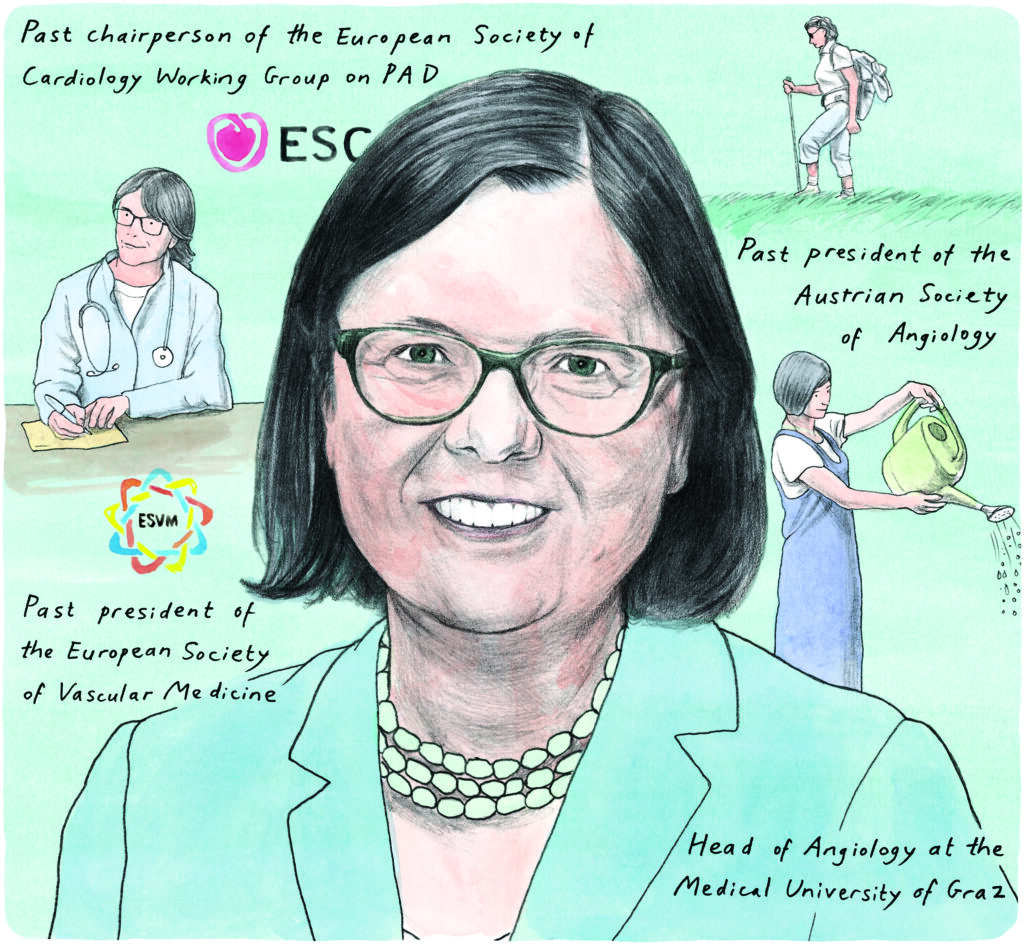
Despite original ambitions to become a journalist, the loss of a close relative to pulmonary embolism (PE) saw Marianne Brodmann (Graz, Austria) redirect her focus towards the medical world. Now the head of the Division of Angiology at the Medical University of Graz, Brodmann talks bioresorbable scaffold technologies, CREST-2, and artificial intelligence (AI) in this interview with Vascular News on her life and career in the vascular field thus far.
Why did you choose to pursue a career in vascular medicine?
A career in vascular medicine was not my first choice. I originally wanted to become a journalist, but my beloved aunt—who was my rock during childhood—died from a PE and that led me towards vascular medicine/angiology. During medical school, I received a grant that allowed me to work in Minneapolis with Kurt Amplatz, which is how I got involved in the endovascular field of vascular medicine specifically.
Who were your career mentors and what was the best advice that they gave you?
The most important mentor I had was Professor Gerhard Stark, who trained me in the endovascular field, gave me the opportunity to do basic research in an animal lab, and was always there to answer questions and provide guidance. He told me: never give up, you will find a solution.
You have been involved in numerous studies on endovascular technologies for the treatment of peripheral arterial disease (PAD). What has been the most important development in this field over the course of your career so far?
The development of the field from plain balloon angioplasty and bare metal stenting to the array of techniques that are now available has been significant. In addition, the importance of how we should approach our endovascular procedures has changed dramatically over the years, with vessel preparation, attention to recoil, and drug deployment all now crucial considerations in current practice.
What do you see as the next frontier in endovascular technologies for PAD?
We need to focus on leaving nothing permanent behind when it comes to endovascular technologies for PAD, especially in patients with chronic limb-threatening ischaemia (CLTI). With this in mind, I think bioresorbable scaffold technologies are the future.
If you leave something behind in a vessel in a patient with CLTI, for example a permanent scaffold, you always need to have in mind that the patient might stop taking their medication. This is especially important to consider when managing a patient with CLTI who is old and particularly sick.
The situation is different in claudicants. Claudicants know that they need to continue to take their medication, their antithrombotic treatment, and that they need to go to the doctor if something is running out, but that’s not the case in CLTI. In a patient with CLTI who has very diseased arteries, you have the dangers of reobstruction, rethrombosis, and then you really get into trouble because if something is permanent in this anatomy, it’s an issue. There might then be a case that requires a bypass, but there is not a landing zone available because there is a scaffold in place.
Therefore, I think if you have something that is in the vessel only for a certain time, maybe six months or 12 months, and then it goes away, it’s much easier to keep the vessel open. This is what is most important from a patient’s perspective and also from a practical perspective.
In addition, bioresorbable scaffolds are associated with less restenosis than nonresorbable scaffolds.
What does the landscape of bioresorbable scaffold technologies for PAD look like at present?
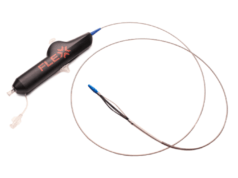
There are currently several bioresorbable scaffold technologies out there at various stages of development, with the field only set to grow in the coming years.
Of course, there is the Esprit below-the-knee (BTK) resorbable scaffold system from Abbott that has been assessed in the LIFE-BTK trial. Most recently, three-year data on this CE mark and US Food and Drug Administration (FDA)-approved device were presented at the 2025 Vascular Interventional Advances (VIVA) conference (2–5 November, Las Vegas, USA), which showed prolonged efficacy and safety in a population of patients with CLTI. Esprit scaffold registries are currently underway in Europe to provide further data on this technology.
The ELITE-BTK pivotal trial is ongoing, which is designed to assess R3 Vascular’s Magnitude drug-eluting bioresorbable scaffold. The company announced in April of last year that the first patient has been treated in this trial, and so we eagerly await the findings.
The Motiv bioresorbable scaffold, from Reva Medical, is another interesting technology in this space. This device has been CE-mark approved and has been granted FDA Breakthrough Device designation. The Motiv is currently being assessed in the recently completed MOTIV BTK randomised controlled trial.
The VITAL-IT 1 study is another one to look out for. This will assess StentIt’s resorbable fibrillated scaffold. This device is not metallic, unlike those listed above, but is instead built from microfibres. The first patient was enrolled in June of last year.
I think there will be a big focus on innovation in the field of bioresorbables in the near future.
What do you think is the most important vascular research paper to have been published in the last 12 months?
Without a doubt the most important paper to have been published in the last year is CREST-2. Published in the New England Journal of Medicine last November, the results of this trial will help us to move forward with carotid treatment at an updated, modern, and adequate level.
For a very, very long time, we would have discussions about how to properly manage patients with asymptomatic carotid stenosis, and more often than not the answer would be that open surgery was the only viable option. In many countries, other surgical options are not available, especially not in Europe. They are done in the USA, but not in Europe.
Patients with high-degree carotid stenosis who are asymptomatic will at some point become symptomatic. You want to avoid this progression and therefore I think if we can offer patients a non-invasive procedure, like stenting, this will be really helpful for all of us. We waited for such a long time for these data, and it is great to see answers to our questions after not having adequate information to share with patients up until now.
The results of CREST-2 are certainly going to influence my day-to-day practice, because I and indeed all my colleagues see a lot of asymptomatic patients. We find them in several ways, whether by duplex ultrasound, under general conditions, or even sometimes by accident when they go for an examination for something unrelated to carotid disease. When these patients are identified, the only option is to just provide medication, and that’s it. Then, inevitably, the patients have to live with the constant fear that at any point they might have a stroke.
It’s not only about us, it’s also about the patient’s fear. These results will make a big difference to patients.
You have held several senior society positions, including president of the European Society of Vascular Medicine and president the Austrian Society of Angiology. How did these roles influence your vascular medicine practice?
I served as president of the European Society of Vascular Medicine from 2017–2018 and was recently awarded an honorary fellowship from this society. Slightly earlier in my career, I served as president of the Austrian Society of Angiology.
These experiences helped me to have an overview of what is done in other fields, other countries, and other institutions, in order to optimise the way we do things in vascular medicine. They also helped me to build connections to improve my level of work and science. Furthermore, I got to know so many people. I have made a lot of friends and formed good relationships while involved with these societies.
One of your main interests is the training of young angiologists. How do you anticipate training will change in the age of AI?
AI will be an important factor in the future, but if you have to treat patients with your own hands as we need to do in the endovascular field, technical skills will remain essential to good clinical practice.
AI might help with guidance, but at the end of the day a physician needs to treat the patient with their own hands and skills.
What are the biggest challenges currently facing vascular surgery and what do you think can be done to address these?
I think the ongoing ‘battle’ between open versus endovascular methods in vascular surgery is one of the biggest challenges we face. Ideally, we need algorithms to help guide us towards the best approach for each individual patient, situation, and set of resources. Could you outline one of your most memorable cases? A PE thrombectomy case from just last year has stayed with me. One of my teachers at medical school had a PE, and the case is particularly memorable because I can distinctly remember bringing her from haemodynamic instability one day, and then two days later she was going to the local coffee shop in our hospital area with her husband.
These are situations and memories you will always have, and they are worth everything.
What advice would you give to someone looking to start a career in medicine?
I would advise anyone looking to start a career in medicine to be patient but determined, because sometimes it takes some time to get the result you want. But it is one of the best jobs you can have. You work with great people, and you can help people and their loved ones.
Consider carefully which medical subspecialty you might be interested in pursuing and don’t be afraid to switch if you discover it is not the way you want to go.
What are your hobbies and interests outside of medicine?
In my spare time I like to work on my nephew’s farm, which was previously my parents’ farm, and I enjoy gardening, with the best time of the year to do this being early spring, in my opinion. I also enjoy hiking and reading books.