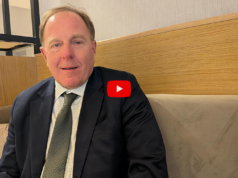
About three years ago, the number of papers in the vascular literature on artificial intelligence (AI) use in vascular surgery was minimal, observes Randy Moore (Calgary, Canada). More recently, that number has spiked to about 12,000, “which really paints a picture of what has happened in the world of AI” as it relates to the specialty, the vascular surgeon and chief medical officer at ViTAA Medical—a company focused on harnessing AI to predict aortic rupture—explains during an interview on the sidelines of the 2025 VEITHsymposium (New York, USA; 18–22 November).
ViTAA staged a breakout mini-symposium during VEITH 2025 attended by world-leading vascular specialists and hosted by Alan Lumsden (Houston, USA). A panel addressed the advance of AI applications in the field, homing in on abdominal aortic aneurysm (AAA) guidelines and the coming together of “imaging excellence” with “AI intelligence”. Afterward, Moore spoke to Vascular News about the rise of AI applications in the field and ViTAA Medical’s recently approved aortic case planning solution, the frontier-pushing AiORTA Plan.