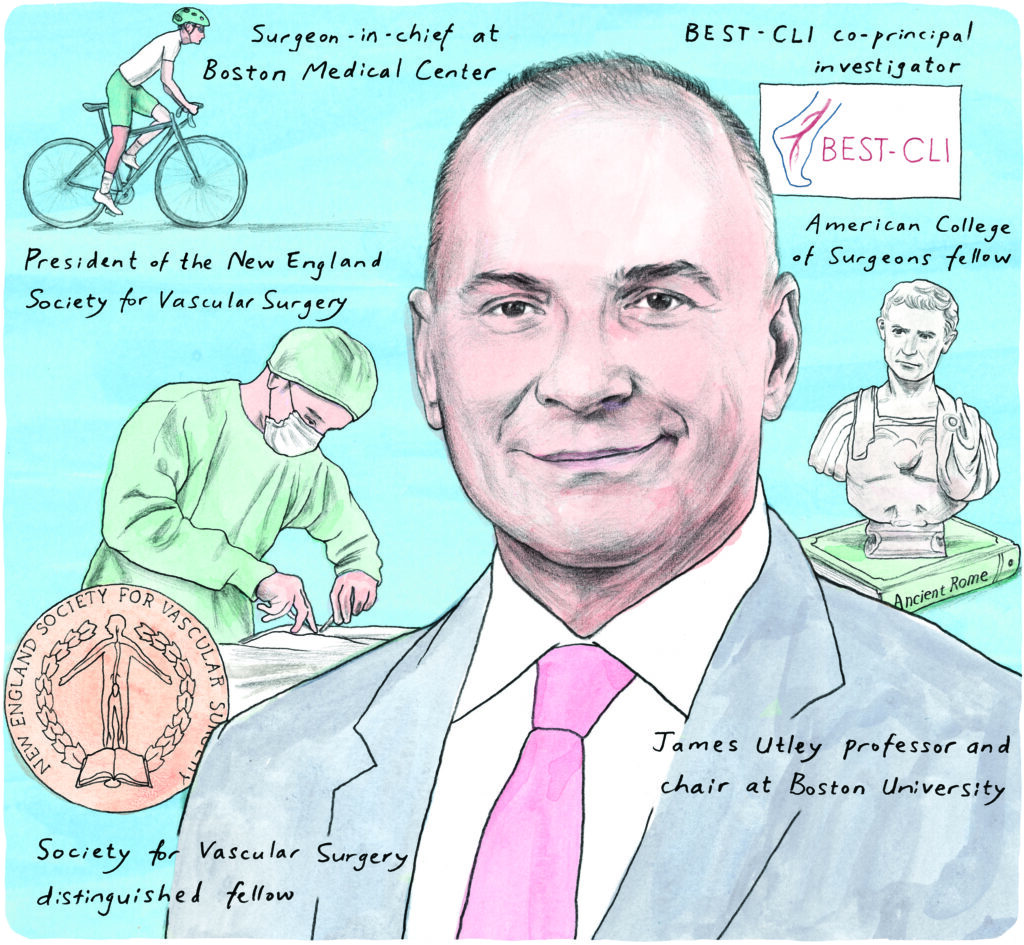
Alik Farber (Boston, USA) speaks to Vascular News about his life and career in vascular surgery. The surgeon-in-chief at Boston Medical Center and James Utley professor and chair of surgery at Boston University Chobanian and Avedisian School of Medicine talks BEST-CLI, his plans for the New England Society for Vascular Surgery (NESVS) as its recently elected president, and the importance of multispecialty collaboration.
Why did you choose a career in medicine and what drew you to vascular surgery in particular?
My parents and I emigrated from Moldova to the USA when I was 10 years old. My father was a surgeon, but he never practised in the USA, instead working multiple jobs—as a butcher, a nurse’s aide, and a newspaper salesman. We had a rough immigration experience, but from an early age, I wanted to be a physician, perhaps to follow in my father’s footsteps. I loved science and I knew that I wanted to help others.
When I was a sophomore at Brown University, I volunteered in the emergency room at Rhode Island Hospital, and after that experience, I was determined to go to medical school. As a third-year medical student at Harvard Medical School, I fell in love with surgery during my clerkship at the Massachusetts General Hospital (MGH) and went on to match there for my residency. Toward the end of my residency, my path to vascular surgery was clear. At the time, my attendings at the MGH were placing endovascular grafts and I found that emerging technology exciting. Being able to do both open surgery and endovascular therapy sealed the deal for me.
Who were your career mentors?
I had a number of mentors. I can’t list all of them, but the ones that come to mind include Richard Paul Cambria, Jack Cronenwett, and Rick Powell.
Rich Cambria was a consummate surgeon who performed thoracic abdominal aneurysm repairs, which are some of the biggest operations that one can perform on a human being. He was a great teacher and an even better speaker.
Jack Cronenwett is one of the most intelligent and knowledgeable surgeons that I’ve ever met. He was an incredible leader and was always focused on improving everyone around him. He was never insecure, always on point, always mentoring, and always reaching for the true north. I’ve tried to model him, not always successfully, in many of my endeavours.
Rick Powell is an incredibly talented open surgeon, a gifted endovascular specialist, a kind human being, the epitome of calm and control. He has been a great mentor and, over the years, became a friend.
You served as co-principal investigator for the landmark BEST-CLI trial. Three years on from the publication of the main findings, have you noticed changes in practice patterns in the management of chronic limb-threatening ischaemia (CLTI)?
The whole BEST-CLI journey is an incredible thing that I still can’t believe actually happened. It started out with an idea that my good friend Matt Menard and I had about answering an important question in our field, and it ended up in us getting the funds necessary to run and then actually execute the trial. BEST-CLI was very hard to complete for many reasons, one being that we were comparing bypass surgery, an invasive procedure, with minimally invasive endovascular therapy. There were all sorts of obstacles, incredible trials and tribulations, but, in the end, with the help of Kenny Rosenfield, who joined us as third national principal investigator, we were successful. Of course, it was not a perfect trial. However, we had very smart people across multiple specialties working together to agree on the best possible protocol. In the end, we got some really interesting answers and added to the badly needed evidence base in the CLTI space.
Our main finding was that, if a patient is at an acceptable risk for open surgery, has complex infrainguinal occlusive disease, an adequate distal target and has good great saphenous vein, they should be considered for infrainguinal bypass. At the time, this suggestion was something of an anathema. It was the wrong thing to say because everybody was moving towards the endovascular-first and, really, endovascular-only approach to treating patients with CLTI.
As to how the trials findings are being implemented, that is still hard to assess accurately. I do hope that vascular specialists are using the available evidence base in guiding best treatment for their patients. We, certainly, have implemented the findings at our centre by changing our practice so that when a patient comes into our hospital with CLTI, they will get vein mapping before they get an angiogram or a computed tomography angiography (CTA) to see whether there’s good vein available or not, and that will drive our treatment decision. How it’s being implemented elsewhere is not yet clear. That is a very important question and, in the near future, we hope to answer it.
What do you think is the most important research paper that has been published in the last 12 months?
I would have to say LIFE-BTK. This study looked at the effect of a drug-eluting resorbable scaffold versus angioplasty in patients who had infrapopliteal disease. The tibial arteries have been the final frontier of intervention for patients with CLTI and really the only thing that’s been standard of care is angioplasty alone, which we know doesn’t work that well. This study is exciting because it showed the scaffold, which elutes everolimus, to work better than angioplasty. I think the positive results of this trial are going to generate further innovation in the tibials.
What are your initial thoughts on the SWEDEPAD results?
I was not surprised. The results mirror what we found in a sub-analysis of BEST-CLI. I think that at the end of the day, we’re all going to move away from paclitaxel towards the limus family of drugs.
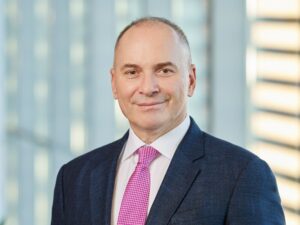
You were recently elected president of the New England Society for Vascular Surgery (NESVS). What are your plans for the year ahead?
The NESVS was the first regional vascular society in the USA. It was founded in 1973 by Robert Linton and R Clement Darling of the MGH and Ralph A Deterling Jr of the New England Medical Center. I remember attending the first meeting of the NESVS as a fellow at Dartmouth Hitchcock Medical Center, and I was instantly impressed with the breadth and depth of the science that was presented. The NESVS is a wonderful, close-knit organiation that hosts an outstanding scientific meeting. I plan to survey our current members to understand what’s important to them and then address these needs. I also aim to grow our membership, even beyond New England, and tweak our meeting to more deeply involve both trainees and allied professionals.
What are the biggest challenges currently facing vascular surgery, and what do you think could be done to address these?
There are several challenges. First is the way the health system is set up, at least in the USA. Due to the fee-for-service model, physicians are incentivised to perform procedures resulting in their overuse. That’s a big problem because, in the end, patients suffer. Frankly, it is not about office-based laboratories (OBLs) versus hospitals, or vascular surgeons versus cardiologists, it’s about having a workforce that is incentivised to do more vascular procedures rather than do the right thing by the patient. That’s a huge problem that we need to tackle, and I believe that it’s up to the vascular surgery, cardiology and radiology communities to collaborate to fix this issue.
The second topic is the relationship between specialists. While the relationships between cardiologists and vascular surgeons is much better than it was 20 years ago, it’s still not as good as it can be. I think there’s an opportunity for all of us to work more closely together to take the best care of our patients.
Thirdly, because of the rise of endovascular technology and growth of endovascular procedures, open vascular surgery is at risk of not being taught and learned as well as it needs to be. There still is and will be a role for open surgery, and, for us to have the best trained vascular workforce, we must be very careful that our vascular surgery training programmes teach both open surgical skills as well as endovascular skills to our trainees.
Could you outline one of your most memorable cases?
One case comes to mind of a middle-aged woman who had an internal carotid aneurysm. This aneurysm was treated by a flow-diverting stent, and the stent pulled out from its distal attachment in the distal internal carotid artery. The interventionalist who was managing this patient wanted to go back and deploy another stent. I was consulted and thought that this was not the right thing to do. We took the patient to the operating room and, because the aneurysm was very high in the neck, the oral surgeons had to split the mandible to provide access for us to get to the internal carotid artery at the base of the skull. We were able to control the aneurysm, and when we opened it, we found the flow-diverting stent attached proximally, but distally waving around in the aneurysm sac. The stent was filled with thrombus. If that patient had gone on to have another stent, she would have certainly embolised this thrombus to her brain. I harvested a piece of saphenous vein and used it to bypass the internal carotid artery. The patient did well.
What advice would you give to someone looking to start a career in medicine generally, or vascular surgery specifically?
I love being a physician and vascular surgeon and as a result, I don’t view going to work every day as working. My advice for those who are starting their careers is to find something you are truly passionate about. Vascular surgery a wonderful field. It provides a tremendous amount of variety and a tremendous degree of satisfaction. Our patient population is getting older and the demand for vascular surgeons is rising. It’s rewarding to be able to have the skillset to take care of patients in the office medically, but then also to treat them in the endovascular suite or operating room using endovascular or open surgical techniques.
What are your hobbies and interests outside of vascular surgery?
My hobby is biking. My wife and I have taken many biking trips across the world, and we really enjoy doing that. It’s a wonderful way to see different countries while exercising. I also love history and in particular ancient Roman and medieval British history. On a recent trip to the UK I was able to visit Battle Abbey, which is the location where the Battle of Hastings took place. This was a fascinating experience.